
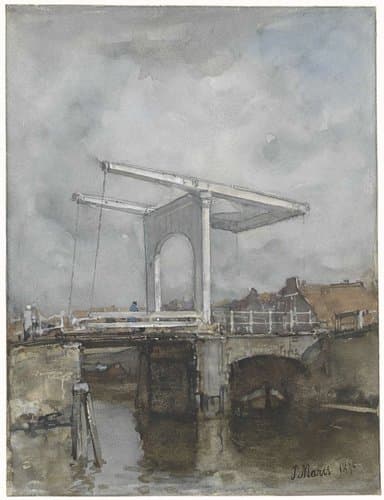
The Drawbridge
1875
Medium
coloures pencil
Dimensions
215; 282
Rights
Public Domain
About this artwork
…; collection Carel Daniël Reich (1837-1922), Amsterdam, 1924;{Jeltes 1924, p.9.} his widow, Anne Elisabeth Reich-Hohwü (1855-1933), Amsterdam; by whom bequeathed, with 38 other drawings, to the museum, 1933
Art Historical Context
**The Drawbridge** by Jacob Maris, created in 1875, the serene Dutch landscape that defined the artist's career. Maris (1837–1899), a leading figure in the Hague School—a 19th movement of Dutch painters celebrated for their realistic depictions of atmospheric light and everyday rural scenes—often portrayed waterways, bridges, and polders. This intimate drawing likely evokes the flat, watery expanses of the Netherlands, where drawbridges were vital for navigation and daily life, symbolizing the nation's engineering ingenuity amid its flood-prone terrain. Rendered in colored pencil on a modest scale (282 × 215 mm), the work showcases Maris's mastery of subtle layering and blending to achieve soft, luminous effects akin to his renowned watercolors and oils. Colored pencil, less common for him, allowed precise control for studies or finished pieces, highlighting textures like weathered wood or misty skies—hallmarks of Hague School naturalism. Once part of Amsterdam collector Carel Daniël Reich's esteemed holdings (noted in 1924), it passed to his widow, Anne Elisabeth Reich-Hohwü, who bequeathed it with 38 other drawings to the museum in 1933. This provenance underscores its value in preserving Maris's graphic legacy, offering visitors a window into 19th-century Dutch artistry.