
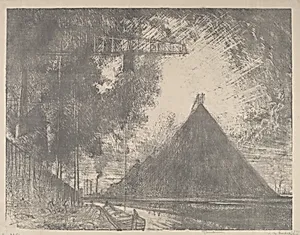
The Dump, Charleroi
1911
Medium
lithograph
Classification
Department
CG-W
Museum
National Gallery of Art, Washington, D.C.
Credit
Rosenwald Collection
Accession Number
1943.3.6985
Rights
Public Domain
Art Historical Context
In the stark lithograph *The Dump, Charler* (1911), American artist Joseph Pennell captures gritty underbelly of early 20th-century industrial Europe. Pennell, master printmaker renowned for his dramatic urban and architectural scenes, visited Belgium's Charleroi region—a hub of coal mining and heavy industry—during a period of rapid modernization. This work depicts a sprawling dump, likely piled with mining waste, evoking the environmental toll of the Industrial Revolution amid smoky factories and belching chimneys. As a lithograph, the piece showcases Pennell's virtuoso technique: he drew directly on limestone with greasy crayon, exploiting the medium's ability to render subtle tones, textures, and atmospheric depth. Printed in black ink on paper, it highlights his realist style—influenced by his friendship with James McNeill Whistler—blending sharp detail with moody contrasts to elevate mundane decay into visual poetry. Pennell's prints often romanticized the machine age, finding beauty in its harshness. Housed in the National Gallery of Art's Rosenwald Collection, *The Dump* reflects growing awareness of industrialization's social costs, offering visitors a poignant glimpse into a transformative era. (198 words)
About the Artist
Joseph Pennell · 1857–1926
Joseph Pennell (1857–1926) was born in Philadelphia to Quaker parents and displayed an early aptitude for drawing, finding solace in sketching amid a challenging childhood. He received initial drawing instruction from James R. Lambdin and his first etching lessons from Stephen Ferris in 1879. Pennell attended night classes at the Pennsylvania Museum and School of Industrial Art before studying at ...