
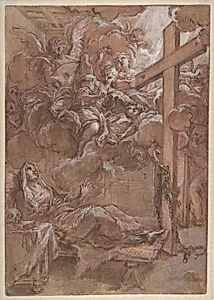
The Ecstacy of the Blessed Giacinta Marescotti
1654–1714
Medium
Pen and brown ink, brush with brown and red wash, over red chalk, highlighted with white gouache
Dimensions
12 11/16 x 8 15/16in. (32.3 x 22.7cm)
Classification
Drawings
Department
Drawings and Prints
Museum
Metropolitan Museum of Art, New York, NY
Credit
Harry G. Sperling Fund, 1992
Accession Number
1992.195
Rights
Public Domain
Tags
Art Historical Context
In the hallowed tradition of 17th-century Roman art, Giuseppe Passeri's *The Ecstasy of the Blessed Giacinta Maresotti* captures a moment of divine rapture. Giacinta Marescotti1585–1640), an Italian mystic and Franciscan tertiary revered for her visions and penances, is depicted in spiritual transcendence, surrounded by symbolic elements like angels, a cross, skulls, and ethereal female figures. Created during Passeri's active years (1654–1714), this drawing reflects the intense religious fervor of the Counter-Reformation era, where artists vividly portrayed saints' ecstasies to inspire devotion. Executed in pen and brown ink with brush and brown/red wash over red chalk, heightened with white gouache, the work exemplifies Baroque preparatory techniques. These mixed media allowed Passeri to achieve dramatic chiaroscuro—deep shadows contrasting luminous highlights—modeling forms with lifelike volume on a modest sheet measuring 12 11/16 x 8 15/16 inches. Such drawings were vital studies for paintings or frescoes, showcasing the artist's mastery in conveying motion and emotion. Housed in the Metropolitan Museum of Art's Drawings and Prints department (acquired via the Harry G. Sperling Fund in 1992), this piece offers a window into Baroque spirituality, blending human vulnerability with celestial glory. Visitors will appreciate its intricate details, evoking the mystical intensity that defined sacred art of the time.
About the Artist
Giuseppe Passeri (Passari) · 1654–1714
**Giuseppe Passeri (1654–1714)** was an Italian painter of the Baroque period, active primarily in his native Rome. Born on 12 March 1654, he trained first with his uncle, the painter and biographer Giovanni Battista Passeri, before entering the studio of the leading Roman artist Carlo Maratta. This rigorous preparation shaped his elegant, classicizing approach to composition and figure drawing, ...