
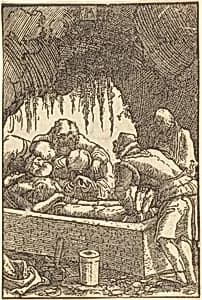
The Entombment
c. 1513
Medium
woodcut on laid paper
Dimensions
sheet (trimmed to block): 7.2 × 4.8 cm (2 13/16 × 1 7/8 in.)
Classification
Department
CG-E
Museum
National Gallery of Art, Washington, D.C.
Credit
Rosenwald Collection
Accession Number
1943.3.358
Rights
Public Domain
Art Historical Context
Albrecht Altdorfer *The Entombment*, created around 1513, is a woodcut on laid paper, measuring just7.2 × 4.8 cm—small enough to fit in the palm of your hand. As a leading figure of the Northern Renaissance and the Danube School, Alorfer was renowned for innovative prints and landscapes, blending meticulous detail with atmospheric depth. This intimate work exemplifies early 16th-century printmaking, a revolutionary technique that allowed artists to produce affordable, reproducible images for widespread devotion during the eve of the Reformation. The scene captures the poignant biblical moment when Christ's body is tenderly lowered into the tomb, surrounded by mourning figures like the Virgin Mary and disciples. Altdorfer's masterful woodcut technique shines in the fine lines and textures, evoking emotion through crowded composition and subtle shading. Woodcuts like this were prized for their clarity and portability, enabling ordinary people to own sacred art that rivaled paintings in spiritual impact. Housed in the National Gallery of Art's Rosenwald Collection (Department CG-E), this print highlights Altdorfer's skill in transforming profound religious narrative into a personal, tactile experience—inviting viewers even today to pause and reflect on themes of loss and redemption.
About the Artist
Albrecht Altdorfer · 1475–1538
Albrecht Altdorfer (c. 1480–1538) was a German painter, printmaker, and draftsman who stands as one of the founders of landscape painting as an independent genre. Born in Regensburg or nearby Altdorf, he learned art from his father Ulrich, a painter and miniaturist. Altdorfer spent most of his life in Regensburg, becoming a citizen in 1505 and later serving as the city's official architect and a m...