
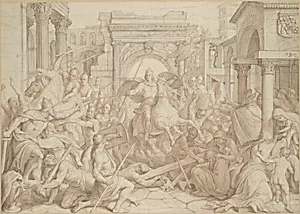
The Entrance of Charlemagne into Pavia
Medium
Black chalk, graphite, brown watercolor washes, red chalk, red chalk washes. Squared for transfer in graphite with numerical indications of vertical divisions at the lower edge
Dimensions
sheet: 18 1/4 x 25 3/4 in. (46.3 x 65.4 cm)
Classification
Drawings
Department
Drawings and Prints
Museum
Metropolitan Museum of Art, New York, NY
Credit
Purchase, Anna-Maria and Stephen Kellen Foundation Gift, 2003
Accession Number
2003.85
Rights
Public Domain
Tags
Art Historical Context
Julius Schnorr von Carolsfeld’s *The Entrance of Charlemagne into Pavia* (1840) captures a pivotal moment from medieval history: the Frankish king’s triumphant entry into the Lombard capital in 774. The drawing brings together soldiers on horseback, townspeople, and children, suggesting both military conquest and civic celebration. As a leading member of the Nazarene movement, Schnorr often turned to grand historical and biblical subjects, seeking to revive the clarity and moral seriousness of early Renaissance art. Created with black chalk, graphite, red chalk, and watercolor washes, the sheet is squared for transfer—an indication that it served as a preparatory study for a larger painting or fresco. The careful layering of media allows Schnorr to model forms and suggest color while maintaining the crisp outlines characteristic of his graphic work. At roughly 18 by 26 inches, the drawing’s scale and detail reveal the artist’s meticulous planning process. The inclusion of women and children alongside armored figures gives the scene a human dimension, reminding viewers that historic events unfolded within everyday communities. Today, the sheet offers a fascinating glimpse into how nineteenth-century artists reimagined the past through careful draftsmanship and rich narrative detail.
About the Artist
Julius Schnorr von Carolsfeld · 1794–1872
German, Leipzig 1794–1872 Dresden