
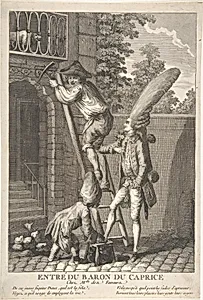
The Entry of the Baron of Caprice to the Home of Miss Favors (Entré du Baron du Caprice chez Melle des Faveurs)
second half 18th century
Medium
Etching
Dimensions
sheet: 13 3/4 x 9 1/16 in. (35 x 23 cm)
Classification
Prints
Department
Drawings and Prints
Museum
Metropolitan Museum of Art, New York, NY
Credit
The Elisha Whittelsey Collection, The Elisha Whittelsey Fund, 1967
Accession Number
67.734.5
Rights
Public Domain
Tags
Art Historical Context
Step into the whimsical world of 18th-century French with *The Entry of the Baron ofrice to the Home of Favors*, an anonymous from the second half of century. This playful caricature a comical scene likely involving exaggerated aristocratic figures—a fanciful "Baron of Caprice" making a bold, perhaps ladder-assisted entrance into the domain of "Miss Favors Vivid tags like men in oversized wigs, dogs, and ladders evoke the era's absurd social rituals, poking fun at courtship, fashion excesses, and capricious nobility. Etchings like this were revolutionary for their time, allowing artists to incise intricate details into metal plates for multiple impressions, making sharp-witted commentary widely accessible through affordable prints. In Enlightenment-era France, such works thrived amid Rococo frivolity and pre-Revolutionary critique, lampooning the powdered wigs and pet obsessions of the elite while hinting at romantic escapades. Housed in the Metropolitan Museum of Art's Drawings and Prints department, this 13¾ x 9⅛-inch sheet from The Elisha Whittelsey Collection exemplifies how anonymous printmakers captured fleeting cultural quirks, inviting us to chuckle at the timeless folly of human pretense.
About the Artist
Anonymous, French, 18th century · 1700–1800
The artist known as Anonymous, French, 18th century, represents a collective of unidentified talents active roughly between 1700 and 1800, a period of profound artistic evolution in France from the opulent Rococo to the austere dawn of Neoclassicism and Revolutionary fervor. Little is documented about their personal training or mentors, as their anonymity obscures individual biographies, though th...