
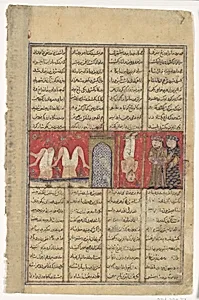
"The Execution of Mazdak", Folio from a Shahnama (Book of Kings)
ca. 1330–40
Medium
Ink, opaque watercolor, gold, and silver on paper
Dimensions
Page: H. 8 1/16 in. (20.5 cm) W. 5 1/4 in. (13.3 cm) Painting: H. 1 5/8 in. (4.1 cm) W. 4 5/16 in. (10.9 cm)
Classification
Codices
Department
Islamic Art
Museum
Metropolitan Museum of Art, New York, NY
Credit
Bequest of Monroe C. Gutman, 1974
Accession Number
1974.290.37
Rights
Public Domain
Tags
Art Historical Context
This exquisite folio from a *Shahnama* (Book of Kings), the epic poem by Abu'l Qasim Firdausi completed around 1010, captures "The Execution of Mazdak in a vivid 14th-century Persian miniature. Dating to ca. 1330–40, it hails from the Ilkhanid period under Mongol rule in Iran, illustrated manuscripts flourished as symbols of royal patronage and cultural revival. The scene depicts the dramatic execution of Mazdak, a 6th-century Zoroastrian reformer whose egalitarian ideas challenged the Sassanian elite, ultimately leading to his demise under King Khosrow I—a pivotal moment blending history, legend, and moral allegory in Persian lore. Crafted with ink outlines, opaque watercolors for brilliant hues, and shimmering gold and silver on paper, the painting exemplifies the refined techniques of Persian illumination. Measuring just 1⅝ × 4⅙ inches, the miniature invites close viewing, its flattened perspective and stylized figures conveying emotion through gesture and pattern rather than realism. Women and men witness the event, highlighting communal themes in Firdausi's narrative. Housed in the Metropolitan Museum of Art's Islamic Art Department (Bequest of Monroe C. Gutman, 1974), this codex page underscores the *Shahnama*'s enduring role in preserving Iran's pre-Islamic heritage amid Islamic artistic traditions, offering visitors a window into medieval storytelling and opulent book arts.
About the Artist
Abu'l Qasim Firdausi · 935–1020
Abu'l Qasim Firdausi, born around 940 in the village of Paj near Tus in Khorasan (modern-day Iran), emerged from a family of landed gentry known as dehqans, who preserved ancient Iranian oral traditions amid the cultural renaissance of the Samanid Empire. Little is documented about his early life or formal training, though he likely received a basic education including Arabic literacy, immersing h...