
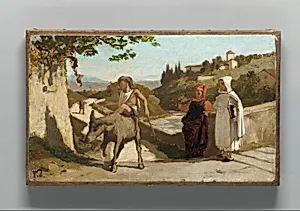
The Fable of the Miller, His Son, and the Donkey No. 3
ca. 1867–68
Medium
Oil on canvas
Dimensions
6 1/2 x 10 3/4 in. (16.5 x 27.3 cm)
Classification
Painting
Culture
American
Department
The American Wing
Museum
Metropolitan Museum of Art, New York, NY
Credit
Gift of John V. and Enza Tomassi Kiskis, 1992
Accession Number
1992.205.3
Rights
Public Domain
Tags
Art Historical Context
Elihu Vedder's *The Fable of the Miller, His Son, and the Donkey No. 3* (ca. 1867–68) is a delightful oil-on-canvas sketch that brings Aesop's timeless moral tale to life. Part of a series inspired by the ancient fable—where a miller and his son learn the folly of trying to please everyone while leading their donkey to market—this small gem (just 6½ × 10¾ inches) captures figures including men, boys, and the stubborn donkey, evoking humor and cautionary wisdom. Vedder, an American artist who immersed himself in Italy's artistic heritage during the 1860s, infused his work with a Pre-Raphaelite-inspired precision and romantic detail. Painted during Vedder's formative European years, the piece reflects his early mastery of oil techniques, using rich glazes to model forms with luminous depth on the intimate canvas. Such modest-scale studies were typical for 19th-century artists refining compositions for larger narratives, blending American ingenuity with European symbolism. The donkey's pivotal role underscores the fable's satire on public opinion. Now in the Metropolitan Museum of Art's American Wing, gifted by John V. and Enza Tomassi Kiskis in 1992, this work highlights Vedder's bridge between Old World fables and New World expression, inviting visitors to ponder: who are we trying to appease today?
About the Artist
Elihu Vedder · 1836–1923
Elihu Vedder was born on February 26, 1836, in New York City to Dr. Elihu Vedder Sr., a dentist, and his cousin Elizabeth Vedder. As a young boy, his family relocated to Cuba for his father's ventures, an experience that sparked his artistic aspirations amid the Caribbean landscapes. He later divided his time between a boarding school and his maternal grandfather Alexander Vedder's home in Schenec...