
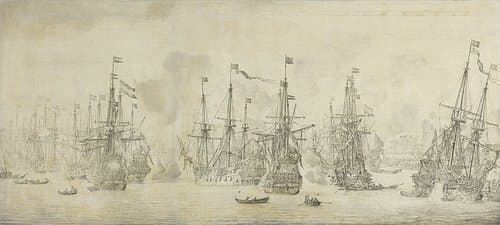
"The Failed Attack of the English on the Return Fleet in the Port of Bergen
Medium
ink on canvas
Dimensions
84; 188; 7
Rights
Public Domain
About this artwork
Het oorspronkelijke schilderij is op enig moment, wanneer onbekend, in drie stukken gesneden. Het linker deel is in 1958 door het National Maritime Museum te Greenwich (GB) aan het Rijksmuseum geschonken, dat sinds 1887 het rechter deel bezit. Een derde afgesneden gedeelte is tot op heden niet getraceerd. Gebaseerd op een schets naar het leven door Willem van de Velde (I) die zich in de collectie van Museum Boijmans Van Beuningen te Rotterdam bevindt, die een goede indruk van de schermutselingen...
Art Historical Context
Willem van de Vel the Elder (1611–1693), a pioneering Dutch marine artist of the Golden Age, captured the chaos of naval warfare in *The Failed Attack of the on the Return Fleet in Port of Bergen* (1669). This large-scale work depicts a dramatic episode from the Second Anglo-D War: the English navy's thwarted assault on the Dutch merchant fleet sheltered in Bergen harbor, Norway, in August 5. Van de Velde's keen eye for maritime detail—honed through his role as an official chronicler of sea battles—brings the skirmishes to life, emphasizing ships' rigging, smoke from cannon fire, and the tense interplay of wind and water. Rendered in ink on canvas (84 × 188 cm), the piece showcases van de Velde's mastery of monochrome washes and precise line work, a technique bridging his famous on-the-spot sketches and fuller oil paintings. Originally a single composition, it was mysteriously cut into three sections at an unknown date. The Rijksmuseum holds the right portion (acquired in 1887) and received the left from London's National Maritime Museum in 1958; the missing middle fragment remains lost. A related life sketch by the artist survives at Rotterdam's Museum Boijmans Van Beuningen, offering vivid insight into the event. This fragmented yet evocative artwork highlights the Dutch Republic's seafaring prowess and van de Velde's innovative "pen paintings," making it a treasured window into 17th-century naval history for visitors.