
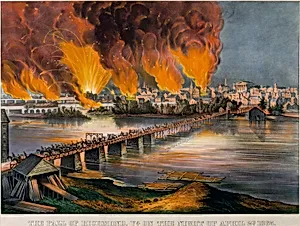
The Fall of Richmond, Virginia, on the Night of April 2nd, 1865
1865
Medium
Hand-colored lithograph
Dimensions
Image: 15 3/4 x 22 1/8 in. (40 x 56.2 cm) Sheet: 17 15/16 × 24 in. (45.5 × 61 cm)
Classification
Prints
Department
Drawings and Prints
Museum
Metropolitan Museum of Art, New York, NY
Credit
Bequest of Adele S. Colgate, 1962
Accession Number
63.550.11
Rights
Public Domain
Tags
Art Historical Context
**The Fall of Richmond Virginia, on the Night of April 2nd, 1865** is a dramatic hand-colored lithograph by the renowned New York firm Currier & Ives, in 1865 amid the final throes of the American Civil. This 15¾ × 22⅛-inch print captures the chaotic evacuation of the Confederate capital, flames engulfing the city, panicked crowds fleeing across bridges, and the James River aglow under a starry night sky. Currier & Ives, masters of affordable mass-produced imagery, specialized in timely scenes like this, blending journalistic urgency with vivid storytelling to reach everyday Americans hungry for war news. Historically, the fall of Richmond marked a turning point: as Union troops under Ulysses S. Grant closed in on April 2, Confederate President Jefferson Davis fled, and fires—set by retreating forces and looters—destroyed warehouses, factories, and bridges, symbolizing the Confederacy's collapse. Just days later, Robert E. Lee surrendered at Appomattox, hastening the war's end. The lithograph's hand-coloring technique, applied by skilled artisans after printing, heightened its emotional impact, with glowing oranges and reds evoking both destruction and the dawn of Union victory. As a cultural artifact now in the Metropolitan Museum of Art's Drawings and Prints collection (Bequest of Adele S. Colgate, 1962), this print reflects how 19th-century Americans consumed history through art—accessible, colorful, and immediate—turning personal tragedy into a shared national narrative of triumph.