
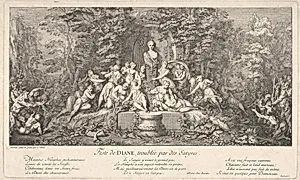
The festival of Diana, interrupted by satyrs (Feste de Diane, troublée par des Satyres): nymphs gathered around the bust of Diana in a stone niche at center, surprised by the arrival of satyrs from either side, from 'Les Bacchanales; Quatres Festes'
Medium
Etching
Dimensions
sheet: 10 1/4 x 15 3/4 in. (26 x 40 cm) plate: 8 11/16 x 14 9/16 in. (22.1 x 37 cm)
Classification
Prints
Department
Drawings and Prints
Museum
Metropolitan Museum of Art, New York, NY
Credit
Bequest of Phyllis Massar, 2011
Accession Number
2012.136.376
Rights
Public Domain
Tags
Art Historical Context
This lively etching captures a moment of mythological drama from classical antiquity, as nymphs gathered in worship around a stone bust of Diana—the Roman goddess of the hunt and chastity—are suddenly startled by mischievous satyrs emerging from the surrounding woods. The central niche frames the goddess’s image as a focal point of ritual, while the dynamic poses of the figures convey surprise and playful tension. Created as part of the series *Les Bacchanales; Quatres Festes*, the print explores themes of revelry and the intrusion of wild nature upon ordered ceremony, blending sacred and sensual elements in a single composition. Claude Gillot, a French draftsman and designer active in the early eighteenth century, supplied the original design in the Rococo spirit, while engraver Pierre François Basan translated it into this etching around 1786. Etching allowed for fluid lines and expressive detail, making such mythological scenes widely accessible beyond elite collectors. The work reflects the period’s fascination with antique festivals and theatrical fantasy, inviting viewers to imagine the lively intersection of divine ritual and untamed woodland spirits. Housed in the Metropolitan Museum of Art’s Department of Drawings and Prints, this impression measures roughly 10 by 16 inches and forms part of a bequest that preserves eighteenth-century French graphic art for modern audiences.
About the Artist
Claude Gillot|Pierre François Basan · 1673–1722
Artist known for his elegant designs done in the Rococo manner of Audran; also for his predilection for scenes from the 'comedia dell'arte.' Few paintings survive; his work is known mainly through drawings and etchings. Comment on works: Genre; History