
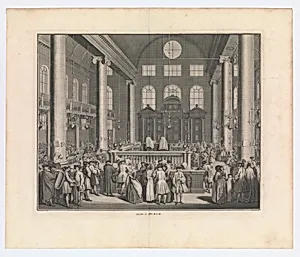
The Festival of Purim (La fête de Purim); Interior of the Portuguese Synagogue in Amsterdam
Medium
Etching and engraving
Dimensions
Sheet: 17 5/16 × 20 11/16 in. (44 × 52.5 cm) Plate: 13 9/16 × 16 5/8 in. (34.5 × 42.2 cm)
Classification
Prints
Department
Drawings and Prints
Museum
Metropolitan Museum of Art, New York, NY
Credit
Gift of Dr. and Mrs. Arthur H. Elkind, in celebration of the Museum’s 150th Anniversary, 2020
Accession Number
2020.272
Rights
Public Domain
Tags
Art Historical Context
In the bustling heart of 18th-century Amsterdam, *The Festival of Purim (La fête de Purim); Interior of the Portuguese Synagogue* captures a joyous moment inside one of the city's grandest Sephardic synagogues. Created in 1737 by Dutch engravers Louis Fabritius Dubourg and Balthasar Bernaerts through meticulous etching and engraving, this print (measuring about 17 x 20 inches) vividly renders the cavernous interior during the exuberant Jewish holiday of Purim. The technique—combining etched lines for texture with engraved details for precision—allowed for intricate depictions of architecture, crowds, and festive attire, making it a prized example of period printmaking. Purim commemorates the ancient deliverance of the Jewish people from persecution in Persia, celebrated with costumes, feasting, and the reading of the Book of Esther. Amsterdam's Portuguese Synagogue, completed in 1675, served as a beacon for Sephardic Jews who had fled the Spanish Inquisition, fostering a thriving community amid the tolerant Dutch Golden Age. This artwork offers a rare glimpse into their vibrant religious life, showcasing the synagogue's opulent sandstone interior, towering arches, and candlelit chandeliers amid revelers. Housed in the Metropolitan Museum of Art's Drawings and Prints department, this gift from 2020 highlights the cultural mosaic of early modern Europe, inviting visitors to appreciate how art preserved fleeting moments of joy and heritage.