
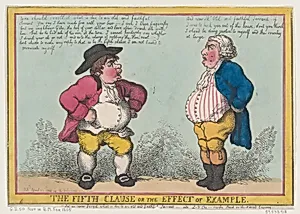
The Fifth Clause, or the Effect of Example
April 23, 1805
Medium
Hand-colored etching
Dimensions
Sheet: 9 in. × 12 13/16 in. (22.8 × 32.5 cm)
Classification
Prints
Department
Drawings and Prints
Museum
Metropolitan Museum of Art, New York, NY
Credit
The Elisha Whittelsey Collection, The Elisha Whittelsey Fund, 1959
Accession Number
59.533.918
Rights
Public Domain
Tags
Art Historical Context
Thomas Rowlandson's *The Fifth Clause, or the Effect of Example* (1805) is a vibrant hand-colored etching that captures the sharp wit of Georgian-era British satire. Created during a turbulent period of the Napole Wars, when political tensions ran high under Prime Minister William Pitt the Younger, Rowlandson skewers contemporary figures and events with his signature exaggerated style. As a leading caricaturist of the late 18th and early 19th centuries, Rowlandson produced thousands of prints mocking politicians, social hypocrisies, and blunders, making complex issues accessible and entertaining to a wide audience. The title slyly references a specific political clause—likely alluding to legislative debates or treaties—while "the Effect of Example highlights Rowlandson's theme of ironic consequences, showing men in absurd, cautionary predic. His loose, fluid lines and bold hand-coloring, applied after etching, add lively humor and visual punch, transforming simple prints into collectible spectacles sold in London's print shops. Housed in the Metropolitan Museum of Art's Drawings and Prints department, this 9 x 12-inch work exemplifies how satire served as a democratic check on power, influencing public opinion without censorship. Visitors today can appreciate Rowlandson's enduring legacy in blending art with activism.
About the Artist
Thomas Rowlandson · 1756–1827
Thomas Rowlandson (1757–1827) was an English artist and caricaturist whose satirical watercolors and prints captured the social life of Georgian Britain with unparalleled wit and technical mastery. Alongside James Gillray, he is recognized as one of the greatest British graphic artists, and his distinctive flowing line and keen observations have made his work integral to understanding late 18th an...