
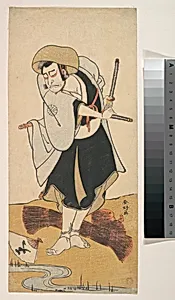
The First Nakamura Nakazo as a Ronin Samurai Attired in a Black Kimono
ca. 1784–88
Medium
Woodblock print; ink and color on paper
Dimensions
12 3/4 x 5 3/4 in. (32.4 x 14.6 cm)
Classification
Prints
Culture & Period
Japan · Edo period (1615–1868)
Department
Asian Art
Museum
Metropolitan Museum of Art, New York, NY
Credit
Purchase, Joseph Pulitzer Bequest, 1918
Accession Number
JP276
Rights
Public Domain
Tags
Art Historical Context
This striking woodblock print by Katsukawa Shunkō captures the celebrated kabuki actor Nakamura Nakazo I in the role of a ronin—a masterless samurai—dressed in a somber black kimono. Created around 1784–88 during Japan’s Edo period, the work belongs to the vibrant tradition of yakusha-e, or actor portraits, which brought the excitement of the kabuki stage to a broad urban audience. Shunkō, a leading artist of the Katsukawa school, was renowned for his ability to convey the distinctive features, expressions, and dynamic poses of individual performers, making each print both a souvenir and a vivid character study. Measuring just over twelve inches tall, the narrow format was typical of hosoban prints designed for quick production and affordable sale. Rendered in ink and color on paper, the image highlights the actor’s commanding presence, with subtle details of his costume and the weapons at his side evoking the ronin’s restless, honorable spirit. Such prints not only celebrated famous actors but also reflected the cultural fascination with samurai ideals during a time of relative peace under the Tokugawa shogunate. Today housed in the Metropolitan Museum of Art, this impression preserves a moment when theater, fashion, and popular art converged, offering modern viewers an intimate glimpse into Edo-period entertainment and the enduring appeal of ukiyo-e.
About the Artist
Katsukawa Shunkō · 1743–1812
Katsukawa Shunkō I (1743–1812) was a Japanese ukiyo-e artist who pioneered the ōkubi-e (large-head) portrait format in kabuki actor prints and served as possibly the first student of Katsukawa Shunshō, the founder of the influential Katsukawa school. Born in 1743, Shunkō spent his entire life in Edo (modern Tokyo), working as both a painter and ukiyo-e printmaker specializing in yakusha-e (actor p...