
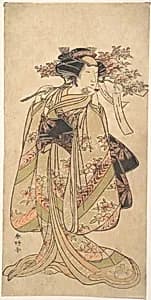
The First Nakamura Tomijuro as a Woman Walking Toward the Left
late 1777 or early in 1778
Medium
Woodblock print; ink and color on paper
Dimensions
11 23/32 x 5 3/4 in. (29.8 x 14.6 cm)
Classification
Prints
Culture & Period
Japan · Edo period (1615–1868)
Department
Asian Art
Museum
Metropolitan Museum of Art, New York, NY
Credit
Purchase, Joseph Pulitzer Bequest, 1918
Accession Number
JP290
Rights
Public Domain
Tags
Art Historical Context
Step into the vibrant world of Edo-period Japan with *The First Nakamura Tomijūrō as a Woman Walking the Left*, a captivating woodblock print by Katsukawa Shunkō (1743–1812). Created in late 1777 or early 1778, this intimate yakusha-e (actor print) measures just 11 23/32 x 5 3/4 inches, the legendary kabuki performer Nakamura Tomijūrō in the graceful role of an onnagata—a male actor specializing in female characters. Shunkō, a master of the ukiyo-e ("pictures of the floating world") school under his teacher Shunshō, captures Tomijūrō's poised stride with elegant kimono folds and a subtle, knowing glance. Woodblock printing, the medium here, revolutionized Japanese art by allowing mass production of colorful images on paper using ink and pigments layered by skilled carvers and printers. These affordable prints brought kabuki theater's glamour to everyday viewers, immortalizing stars like Tomijūrō, who debuted as an onnagata in 1752 and became an icon of feminine poise on stage. During the Edo period (1615–1868), such depictions blurred gender lines, celebrating performance as high art amid urban pleasures. This Met Museum treasure, acquired via the Joseph Pulitzer Bequest in 1918, highlights ukiyo-e's global influence on modern artists like Van Gogh. Gaze closely at the dynamic composition—Tomijūrō glides leftward, evoking the theater's rhythm and Japan's enduring love for beauty in motion.
About the Artist
Katsukawa Shunkō · 1743–1812
Katsukawa Shunkō I (1743–1812) was a Japanese ukiyo-e artist who pioneered the ōkubi-e (large-head) portrait format in kabuki actor prints and served as possibly the first student of Katsukawa Shunshō, the founder of the influential Katsukawa school. Born in 1743, Shunkō spent his entire life in Edo (modern Tokyo), working as both a painter and ukiyo-e printmaker specializing in yakusha-e (actor p...