
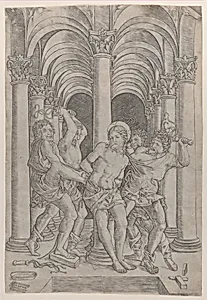
The Flagellation of Christ who is tied to a column at center set within an arcade
Medium
Engraving
Dimensions
Sheet (Trimmed): 16 5/8 × 11 1/4 in. (42.2 × 28.6 cm)
Classification
Prints
Department
Drawings and Prints
Museum
Metropolitan Museum of Art, New York, NY
Credit
Harris Brisbane Dick Fund, 1925
Accession Number
25.2.31
Rights
Public Domain
Art Historical Context
In the heart of the High Renaissance, Giovanni Antonio da Brescia crafted *The Flagellation of Christ* in 1509, a striking engraving that captures a pivotal moment from Christian iconography. Christ, bound to a central column within a grand arcade, endures scourging by tormentors, evoking profound pathos and devotion. Da Brescia, a skilled Italian printmaker from Brescia active in Venice, exemplifies the era's mastery of engraving—a technique where intricate lines are incised into copper plates to produce detailed, reproducible images on paper. This large-scale print, measuring 16 5/8 × 11 1/4 inches (trimmed), highlights engraving's revolutionary role in democratizing art. Before photography, such works allowed pilgrims and collectors across Europe to own vivid replicas of sacred scenes, spreading Renaissance humanism and religious fervor. Da Brescia's precise linework and architectural framing draw from Venetian traditions, blending emotional intensity with classical harmony. Acquired through the Harris Brisbane Dick Fund in 1925, this piece resides in the Metropolitan Museum of Art's Drawings and Prints department. It invites visitors to ponder not just Christ's suffering, but the power of printmaking to bridge faith and artistry in early 16th-century Italy.