
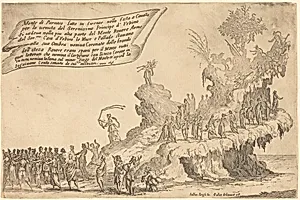
The Float of Mount Parnassus
1616
Medium
etching on laid paper
Dimensions
sheet (trimmed to plate mark): 15 × 22.6 cm (5 7/8 × 8 7/8 in.)
Classification
Department
CG-E
Museum
National Gallery of Art, Washington, D.C.
Credit
Rosenwald Collection
Accession Number
1949.5.334
Rights
Public Domain
Art Historical Context
Jacques Callot's *The Float of Mount Parnus* (1616) is a captivating etching on laid paper, measuring just 15 × 22.6 cm, showcasing the artist's mastery of miniature grandeur. Created during Callot's time in Florence under Medici patronage, this print likely depicts a fantastical festival float inspired by Mount Parnassus—the mythical Greek home of Apollo and the Muses, symbolizing poetry, music, and the arts. Such whimsical inventions reflect the opulent courtly entertainments of early 17th-century Italy, blending mythology with spectacle. Callot, a pioneering French Baroque printmaker, revolutionized etching with his ultra-fine needlework, allowing intricate details in tiny formats. Here, the laid paper—common for the era's high-quality prints—holds his precise lines, evoking bustling crowds and elaborate architecture on a barge-like float. This technique made his works accessible yet exquisite, influencing later artists like Rembrandt. Housed in the National Gallery of Art's Rosenwald Collection, this piece highlights Callot's role in elevating prints from mere reproductions to standalone artworks, inviting viewers to marvel at a world of imagined revelry preserved in delicate ink.
About the Artist
Jacques Callot · 1592–1635
Jacques Callot (1592–1635) was a French printmaker and draftsman from the Duchy of Lorraine, widely regarded as one of the first great artists to practice the graphic arts exclusively. His more than 1,400 etchings chronicled the breadth of 17th-century life, from Medici court festivities to the brutal realities of warfare. Callot revolutionized etching through technical innovations including the é...