
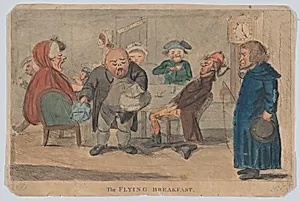
The Flying Breakfast, or Contents of a Night Coach
Medium
Hand-colored etching
Dimensions
Sheet (trimmed within plateline): 8 9/16 × 12 7/8 in. (21.8 × 32.7 cm)
Classification
Prints
Department
Drawings and Prints
Museum
Metropolitan Museum of Art, New York, NY
Credit
Purchase, Harry G. Friedman Bequest, 1967
Accession Number
67.539.63
Rights
Public Domain
Tags
Art Historical Context
Step into the bumpy world of 18th British travel with Thomas Rowlandson's *The Flying Breakfast, or Contents of a Night Coach* (1792), a hand-colored etching that captures the chaos of a nighttime stagecoach journey. Published by S.W. Fores, this satirical print humorously depicts cramped passengers—men and women from various walks of life—enduring the jolts of the road, with the titular "flying breakfast" likely alluding to the messy indignities of motion sickness amid overturned food and drink. Rowlandson, a master of caricature during the Georgian era, skewers the discomforts and social awkwardness of public coaching, a primary mode of long-distance travel before railroads. His exaggerated figures and dynamic compositions highlight class tensions and human folly, reflecting the booming print culture that made such commentary accessible to a wide audience. The hand-coloring enhances the etching's lively appeal, with vibrant hues amplifying the farce for affordable sale as a single sheet (8 9/16 × 12 7/8 in.). Acquired by The Metropolitan Museum of Art in 1967, this piece endures as a witty snapshot of everyday life, reminding us how satire has long poked fun at travel's trials.
About the Artist
Thomas Rowlandson|Anonymous, British, 18th century|S. W. Fores · 1756–1827
Thomas Rowlandson (1757–1827) was an English artist and caricaturist whose satirical watercolors and prints captured the social life of Georgian Britain with unparalleled wit and technical mastery. Alongside James Gillray, he is recognized as one of the greatest British graphic artists, and his distinctive flowing line and keen observations have made his work integral to understanding late 18th an...