
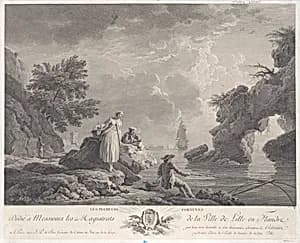
The Fortunate Fishermen
Medium
Engraving
Dimensions
Sheet (Trimmed): 13 3/4 in. × 17 in. (35 × 43.2 cm)
Classification
Prints
Department
Drawings and Prints
Museum
Metropolitan Museum of Art, New York, NY
Credit
Harris Brisbane Dick Fund, 1953
Accession Number
53.600.1525
Rights
Public Domain
About this artwork
This prints titled "The Fortunate Fishermen" by Joseph Vernet|Isidore Stanislas Henri Helman dates to ca. 1770. Executed in engraving, this work exemplifies the craftsmanship associated with Drawings and Prints. The piece demonstrates the technical skill and artistic vision characteristic of its period. The work's presence in a major museum collection attests to its significance in the broader narrative of art history. As part of institutional holdings, it serves both scholarly research and publ...
Art Historical Context
Created around 1770, “The Fortunate Fishermen” is an engraving that pairs the marine expertise of painter Joseph Vernet with the technical skill of engraver Isidore Stanislas Henri Helman. Vernet, celebrated for his luminous seascapes, supplied the original composition, while Helman translated its atmospheric effects into the precise lines of an engraving. The resulting print measures roughly 13¾ by 17 inches, a size well suited for both private collectors and wider circulation. In the eighteenth century, engravings after celebrated paintings allowed images of idyllic coastal life to reach audiences far beyond the walls of aristocratic salons. Vernet’s scenes often evoked the calm pleasures of the French shoreline, reflecting Enlightenment-era fascination with nature and human harmony with the sea. Helman’s meticulous burin work preserved the play of light on water and the quiet drama of the fishermen’s catch, demonstrating how reproductive prints extended an artist’s vision. Acquired by the Metropolitan Museum of Art through the Harris Brisbane Dick Fund in 1953, this impression now preserves a moment when painting and printmaking worked together to shape popular taste. Its presence in the Drawings and Prints collection underscores the enduring appeal of Vernet’s marine subjects and the vital role of engraving in eighteenth-century visual culture.