
The Fountain
1835–1904
Medium
Pen and dark brown ink, brush and gray and brown wash
Dimensions
Drawing: 5 5/16 x 3 1/2 in. (13.5 x 8.9 cm) Sheet: 6 7/8 x 4 13/16 in. (17.5 x 12.2 cm)
Classification
Drawings
Department
Drawings and Prints
Museum
Metropolitan Museum of Art, New York, NY
Credit
Gift of Lincoln Kirstein, 1966
Accession Number
66.576.10(3)
Rights
Public Domain
Tags
Art Historical Context
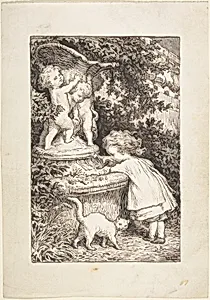
Created by Danish artist Lorenz Frølich between 1835 and 1904, *The Fountain* is a delicate pen-and-ink drawing heightened with gray and brown washes. Measuring just over five inches tall, the compact sheet captures a lively outdoor scene centered on a decorative fountain. Frølich’s fluid linework and subtle tonal washes bring depth to the cascading water, surrounding foliage, and playful figures, demonstrating the technical finesse typical of 19th-century European draftsmanship. The composition features girls, putti, and cats amid leafy details, suggesting a whimsical, almost storybook atmosphere. Such motifs were popular in Frølich’s era, reflecting Romantic interests in childhood innocence and classical mythology. The drawing’s intimate scale and careful layering of ink and wash reveal an artist attuned to both narrative charm and the expressive possibilities of mixed media. Now part of the Metropolitan Museum’s Department of Drawings and Prints, the work entered the collection in 1966 as a gift from Lincoln Kirstein. It offers visitors a charming glimpse into Frølich’s illustrative sensibility and the enduring appeal of fountain imagery as a symbol of vitality and renewal.
About the Artist
Lorenz Frølich · 1820–1908
**Lorenz Frølich (1820–1908) was a Danish painter, illustrator, graphic artist, and etcher whose career bridged traditional academic training with a celebrated international reputation for book illustration.** Born into a wealthy bourgeois family in Copenhagen on 25 October 1820, he showed an early talent for drawing. He received private instruction from Martinus Rørbye starting in 1833, and later...