
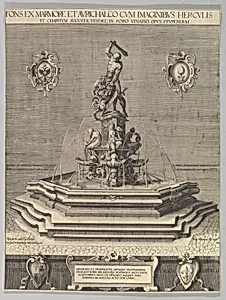
The Fountain of Hercules in Augsburg, a reduced copy afer Muller's engraving
Medium
Engraving
Dimensions
Sheet: 18 1/2 in. × 14 in. (47 × 35.5 cm)
Classification
Prints
Department
Drawings and Prints
Museum
Metropolitan Museum of Art, New York, NY
Credit
The Elisha Whittelsey Collection, The Elisha Whittelsey Fund, 1955
Accession Number
56.597.47
Rights
Public Domain
Tags
Art Historical Context
Step into the grandeur of 17th-century Augsburg with *The Fountain of Hercules in Aug*, a meticulous 1602 engraving that captures the splendor of Adriaen de's celebrated bronze sculpture. Created as a reduced copy after an engraving by Jan Muller, this print also bears the hand of Wolfgang Kilian, blending the talents of Dutch and German masters. Measuring 18½ × 14 inches, it vividly depicts the dynamic figure of Hercules amid cascading waters, adorned with intricate insignia that evoke the city's civic pride and Renaissance humanism. Adriaen de Vries, a leading Mannerist sculptor, designed the fountain around 1600 for Augsburg's town hall square, symbolizing strength and civic virtue during the Holy Roman Empire's opulent era. Hercules, the mythic hero, triumphs over fantastical beasts, reflecting the era's fascination with classical mythology and imperial power. This print served as a vital means of disseminating such architectural marvels across Europe, allowing collectors to own a piece of the spectacle. As an engraving from the Metropolitan Museum of Art's Elisha Whittelsey Collection, it exemplifies reproductive printmaking's artistry—fine lines and tonal depth bringing stone and water to life on paper. A testament to early modern collaboration, it invites us to marvel at how prints bridged art and patronage in the Baroque dawn.
About the Artist
Jan Muller|Wolfgang Kilian|Adriaen de Vries · 1571–1628
**Jan Harmensz. Muller (1571–1628)** Born in Amsterdam in 1571, Jan Harmensz. Muller grew up immersed in the world of printmaking, as the son of the prominent engraver, publisher, and book printer Harmen Jansz. Muller. He studied under his father, mastering the engraving trade within the family business, The Gilded Compasses. Around 1589, Muller joined the workshop of Hendrick Goltzius in Haarlem...