
The Four Angels Staying the Winds, from The Apocalypse
c. 1496–98, published 1511
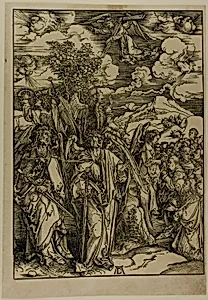
Medium
Woodcut in black on tan laid paper
Dimensions
Image: 39.5 × 28.3 cm (15 9/16 × 11 3/16 in.); Sheet: 43.3 × 30.2 cm (17 1/16 × 11 15/16 in.)
Classification
woodcut
Department
Prints and Drawings
Museum
Art Institute of Chicago
Accession Number
122253
Rights
Public Domain
Art Historical Context
Albrecht Dürer’s *The Four Angels Staying the Winds* is a striking woodcut from his celebrated *Apocalypse* series, created around 1496–98 and later published in 1511. This work illustrates a dramatic moment from the Book of Revelation, where four angels restrain the winds to protect the earth. As one of the most ambitious print projects of the Northern Renaissance, the series established Dürer as a master of graphic art and brought vivid biblical imagery to a wide audience through the power of the printing press. Executed in black ink on tan laid paper, the woodcut showcases Dürer’s extraordinary skill in the medium. He carved intricate details into the woodblock to convey swirling drapery, expressive figures, and a sense of dynamic movement, all within a compact yet monumental composition. Woodcuts like this were revolutionary for their time, allowing complex narratives to be reproduced affordably and distributed across Europe. The *Apocalypse* series captured the spiritual anxieties of the late fifteenth and early sixteenth centuries, resonating with viewers amid religious upheaval and the approach of the year 1500. Today, this print in the Art Institute of Chicago’s collection remains a testament to Dürer’s innovative vision and the enduring power of printmaking to shape cultural imagination.
About the Artist
Albrecht Dürer · 1471–1528
Albrecht Dürer (1471–1528) stands as the preeminent figure of the Northern Renaissance and arguably the most influential artist in the history of printmaking. Born in Nuremberg on May 21, 1471, and dying in the same city on April 6, 1528, Dürer revolutionized the status of the artist in Northern Europe, transforming printmaking from a commercial craft into an independent fine art and establishing ...