
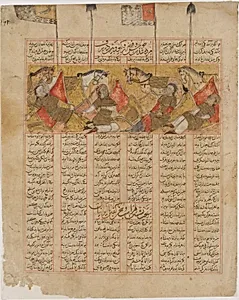
"The Four Knights of Kai Khusrau in the Mountains", Folio from a Shahnama (Book of Kings)
Medium
Ink, opaque watercolor, and gold on paper
Dimensions
Page: H. 14 1/2 in. (36.8 cm) W. 11 5/16 in. (28.7 cm) Painting: H. 6 3/8 in. (16.2 cm) W. 9 5/16 in. (23.6 cm) Mat: H. 22 in. (55.9 cm) W. 16 in. (40.6 cm)
Classification
Codices
Department
Islamic Art
Museum
Metropolitan Museum of Art, New York, NY
Credit
Rogers Fund, 1936
Accession Number
36.113.2
Rights
Public Domain
Tags
Art Historical Context
Step into the epic world of Persia's *Shahnama* (Book of Kings), the monumental 10th-century poem by Abu'l Qasim Firdausi that the mythical history of Iranian kings and heroes. This exquisite folio, dated 1341 CE, captures "The Four Knights of Kai Khusrau the Mountains," illustrating a dramatic moment from the reign of the legendary king Kai Khusrau Produced by skilled artisans including al-Hasan Qam al-Daula wa'l-Din and Hasan Muhammad ibn `Ali ibn (?) Husaini (known as al-Mausili), it exemplifies 14th-century Persian manuscript illumination from the Islamic world. Crafted with ink, opaque watercolor, and gold on paper, the painting measures about 6⅜ by 9⅜ inches, set within a larger folio page. The vibrant, gouache-like watercolors and shimmering gold highlights bring the knights—mounted on rearing horses amid rugged peaks—to vivid life. This technique, characteristic of Persian miniatures, emphasizes flattened perspectives, intricate patterns, and dynamic compositions that blend narrative storytelling with decorative splendor, making codices like this prized treasures for royal patrons. Housed in the Metropolitan Museum of Art's Islamic Art Department (Rogers Fund, 1936), this folio reflects the cultural revival of Persian identity under post-Mongol rule. It not only preserves Firdausi's heroic tales but also showcases the fusion of poetry, calligraphy, and painting, inviting viewers to ponder the valor of ancient knights in a timeless mountain saga.
About the Artist
Abu'l Qasim Firdausi|al-Hasan Qawam al-Daula wa'l-Din|Hasan ibn Muhammad ibn `Ali ibn (?) Husaini, known as al-Mausili · 935–1020
Abu'l Qasim Firdausi, born around 940 in the village of Paj near Tus in Khorasan (modern-day Iran), emerged from a family of landed gentry known as dehqans, who preserved ancient Iranian oral traditions amid the cultural renaissance of the Samanid Empire. Little is documented about his early life or formal training, though he likely received a basic education including Arabic literacy, immersing h...