
The Fourth Iwai Hanshiro in three roles of the shosa "Shichi Henge"
dated 1787
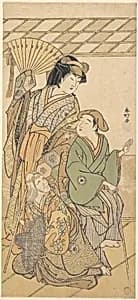
Medium
Middle sheet of a triptych of woodblock prints; ink and color on paper
Dimensions
12 3/4 x 5 3/4 in. (32.4 x 14.6 cm)
Classification
Prints
Culture & Period
Japan · Edo period (1615–1868)
Department
Asian Art
Museum
Metropolitan Museum of Art, New York, NY
Credit
Rogers Fund, 1914
Accession Number
JP169
Rights
Public Domain
Tags
Art Historical Context
Step into the vibrant world of Edo-period Japan *The Fourth Iwai Hansh in three roles of theosa "Shichi H"*, a masterful 1787 woodblock print by Katsukawa Shunk. This middle sheet of a triptych captures the celebrated kabuki actor Iwaihirō IV mid-transformation in the dynamic dance *Shichi Henge*Seven Transformations"), where performers dazzle audiences by swiftly switching costumes and personas. Shunkō, a leading figure in the Katsukawa school of ukiyo-e ("pictures of the floating world"), excels in yakusha-e—intimate portraits of theater stars—blending sharp lines and vivid colors to convey the actors' expressive faces, flowing robes, fans, and poised gestures. Produced during Japan's Edo period (1615–1868), when kabuki theater thrived as popular entertainment, this print reflects ukiyo-e's cultural boom. Affordable woodblock prints like this one democratized art, allowing commoners to own glimpses of superstar actors. The triptych format enhances the drama, unfolding across three sheets to mimic the stage's breadth and the performer's multifaceted roles, often blurring gender lines with onnagata (male actors playing women). Shunkō's technique—ink and color layered on paper via intricate woodblocks—highlights theatrical realism and emotional intensity, making this 12¾ × 5¾ in. gem a window into 18th-century Tokyo's lively playhouses. On view in the Metropolitan Museum of Art's Asian Art collection (Rogers Fund, 1914), it celebrates performance as high art.
About the Artist
Katsukawa Shunkō · 1743–1812
Katsukawa Shunkō I (1743–1812) was a Japanese ukiyo-e artist who pioneered the ōkubi-e (large-head) portrait format in kabuki actor prints and served as possibly the first student of Katsukawa Shunshō, the founder of the influential Katsukawa school. Born in 1743, Shunkō spent his entire life in Edo (modern Tokyo), working as both a painter and ukiyo-e printmaker specializing in yakusha-e (actor p...