
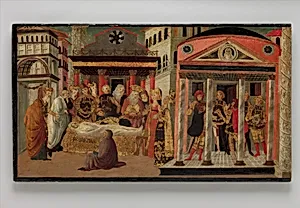
The Funeral of Lucretia
late 15th–early 16th century
Medium
Tempera and gold on wood
Dimensions
Overall 15 5/8 x 27 1/2 in. (39.7 x 69.9 cm); painted surface 15 x 27 1/8 in. (38.1 x 68.9 cm)
Classification
Paintings
Department
Robert Lehman Collection
Museum
Metropolitan Museum of Art, New York, NY
Credit
Robert Lehman Collection, 1975
Accession Number
1975.1.76
Rights
Public Domain
Tags
Art Historical Context
In the late 15th to early 16th century the enigmatic Master of Marradi crafted *The Funeral of Lucret*, a poignant tempera and gold panel on wood now housed in the Metropolitan Museum of Art's Robert Lehman Collection. Italian Renaissance work, measuring about 15½ by 27½ inches, exemplifies the era's narrative painting traditions, likely serving as a predella panel beneath a larger altarpiece. The style draws from Florentine masters like Domenico Ghirlandaio, blending meticulous detail with emotional depth in scenes of moral gravity. The painting depicts the funeral procession of Lucretia, the Roman matron whose tragic tale captivated Renaissance audiences. According to ancient sources like Livy, Lucretia took her own life after being violated by a tyrant's son, igniting Rome's revolt against its kings and birthing the Republic. Here, mourners—men and women in period attire—gather in solemn tribute, symbolizing virtues of chastity, honor, and civic duty that resonated deeply in an age of political upheaval and humanist revival. The use of tempera, a fine egg-based medium, allowed for luminous colors and intricate gold highlights that evoke sacred illumination, while the horizontal format heightens the dramatic procession. This artwork invites visitors to ponder timeless themes of sacrifice and justice, bridging antiquity with Renaissance piety.