
The Genius of Salvator Rosa
ca. 1662
Medium
Etching with drypoint
Dimensions
Sheet: 17 15/16 x 10 7/8 in. (45.6 x 27.6 cm)
Classification
Prints
Department
Drawings and Prints
Museum
Metropolitan Museum of Art, New York, NY
Credit
Bequest of Phyllis Massar, 2011
Accession Number
2012.136.847
Rights
Public Domain
Tags
Art Historical Context
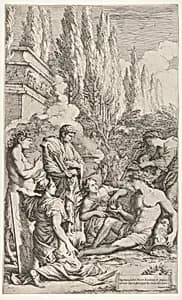
**The Genius of Salvator Rosa** (ca. 1662) is a striking self-referential etching by the Italian Baroque artist Salvator Rosa (1615–1673), now housed in the Metropolitan Museum of Art's Drawings and Prints department. Rosa, a master of dramatic landscapes and turbulent seascapes, was a pioneering figure in 17th-century printmaking, producing around 100 etchings that captured his rebellious spirit and romantic sensibility. This work, measuring nearly 18 by 11 inches, embodies his flair for allegory, likely depicting the artist's own "genius"—a classical symbol of creative inspiration—amidst male and female figures and evocative trees, blending portraiture with landscape elements. Crafted in etching with drypoint, the piece showcases Rosa's technical virtuosity. Etching involves biting lines into a metal plate with acid for precise, fluid strokes, while drypoint adds a soft, velvety burr from direct engraving, lending richness and texture to the forms. This combination allowed Rosa to evoke the wild energy of nature and human emotion, hallmarks of his proto-Romantic style that influenced later artists like Rembrandt and the Romantics. As a bequest from Phyllis Massar in 2011, this print highlights Rosa's cultural legacy as a self-mythologizer who challenged academic norms. It invites visitors to ponder the artist's bold self-image, bridging Baroque intensity with personal genius in an accessible yet profound medium.
About the Artist
Salvator Rosa · 1615–1673
Salvator Rosa was born in 1615 in Arenella, on the outskirts of Naples, into a world of artistic ambition and turbulent talent. His early training came through his maternal uncle, the painter Paolo Greco, and his brother-in-law Francesco Fracanzano, himself a pupil of the great Spanish-born Neapolitan master Jusepe de Ribera. Rosa showed a fierce independence from the start, resisting his father's...