
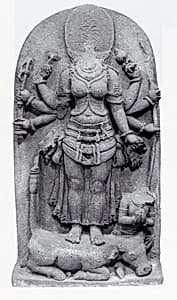
The Goddess Durga Victorious over the Buffalo Demon, Mahisha (Mahishasuramardini)
Unknown Artist
9th century
Medium
Volcanic stone (Andesite)
Dimensions
H. 60 1/16 in. (152.5 cm)
Classification
Sculpture
Culture & Period
Indonesia (Java) · Central Javanese period
Department
Asian Art
Museum
Metropolitan Museum of Art, New York, NY
Credit
Purchase, Friends of Asian Art Gifts, Mr. and Mrs. Donald Bruckmann, Mr. and Mrs. Perry J. Lewis, and Anonymous Gifts, 1988
Accession Number
1988.160
Rights
Public Domain
Tags
Art Historical Context
This monumental sculpture from 9th-century Java captures the triumphant Hindu goddess Durga, known as Mahishasuramardini, slaying the buffalo demon Mahisha. Carved in the Central Javanese period, vividly depicts the divine warrior poised in dynamic victory, her multiple arms wielding weapons to pierce the demon's form—a classic icon of good prevailing over evil in Hindu mythology. Standing over five feet tall (60 1/16 in. high), the figure commands awe, embodying the era's reverence for protective deities. Crafted from durable volcanic andesite stone, quarried locally from Java's volcanic landscapes, the artwork showcases masterful stone carving techniques. Artisans achieved intricate details in Durga's jewelry, musculature, and the demon's agonized expression, highlighting the technical prowess of Central Javanese sculptors who blended Hindu devotional themes with indigenous styles. This medium's resilience has preserved the piece for over a millennium. Housed in the Metropolitan Museum of Art's Asian Art Department, this rare survivor from Java's Hindu golden age underscores the island's role as a cultural crossroads, where Indian epics inspired monumental temple art before Islamic influences arrived. Visitors are drawn to its raw power, a testament to enduring spiritual narratives.