
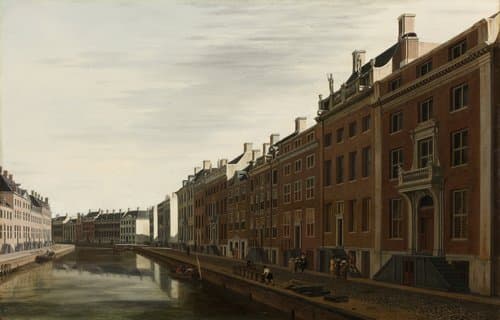
The ‘Golden Bend’ in the Herengracht, Amsterdam, Seen from the West
Medium
oil on panel
Dimensions
59.7; 7; 81; 40.5; 63
Rights
Public Domain
About this artwork
…; collection Jacques Goudstikker (1897-1940), Amsterdam, 1933?-40;{Goudstikker, black book, 1940, p. 12, no. 2198.} …; from the Dutch State, fl. 2,000, to Dési Goudstikker, née von Halban (1912-96), 1952;{Note RMA.} from whom, fl. 310,000, to the museum, with support from the Rijksmuseum Stichting and the Ministerie van Cultuur, Recreatie en Maatschappelijk Werk, 1980
Art Historical Context
Gerrit Berckheyde’s 1672 oil painting captures the elegant “Golden Bend” along Amsterdam’s Herengracht canal, viewed from the west. This refined cityscape highlights the stately facades and tree-lined waterway that symbolized the wealth of the Dutch Republic’s merchant elite during the height of the Golden Age. The compact panel, measuring just 40.5 by 63 centimeters, invites close inspection of the precise architectural details that characterize Berckheyde’s work. Painted in oil on panel—a medium prized for its smooth surface and luminous finish—the scene reflects the period’s pride in urban planning and civic prosperity. Berckheyde, known for his meticulous topographical views, recorded the canal’s distinctive curve and grand residences with clarity and restraint, offering viewers a window into seventeenth-century Amsterdam’s social and economic vitality. Today in the Rijksmuseum collection, the work preserves a moment when the city’s canals were both practical thoroughfares and showcases of architectural ambition. Its modest scale belies the breadth of historical insight it provides into Dutch urban life at its most confident.