
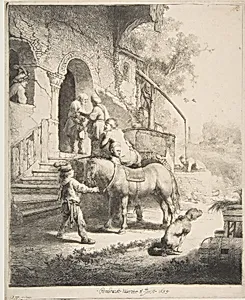
The Good Samaritan
Medium
Etching, engraving and drypoint; fourth state of four
Dimensions
Sheet: 10 5/16 × 8 3/8 in. (26.2 × 21.3 cm) Plate: 10 3/16 × 8 1/16 in. (25.8 × 20.5 cm)
Classification
Prints
Department
Drawings and Prints
Museum
Metropolitan Museum of Art, New York, NY
Credit
Gift of Felix M. Warburg and his family, 1941
Accession Number
41.1.54
Rights
Public Domain
Tags
Art Historical Context
Rembrandt van Rijn's *The Good Samaritan* (1633 is a masterful etching that brings to life the New Testament parable from Luke , where a compassionate Samaritan aids a traveler beaten by robbers and ignored by passersby. In this poignant scene, we see the Samaritan gently assisting the wounded man at an inn, surrounded by evocative details like a horse, a loyal dog, a boy at a well, and figures bustling in the background. Created early in Rembrandt's career, print captures his signature Baroque drama through deep shadows and emotional intensity, emphasizing themes of mercy and humanity that resonated in 17th-century Dutch society. Printed in etching, engraving, and drypoint—this being the fourth and final state of four—the work showcases Rembrandt's innovative printmaking genius. He combined etched lines for precision with engraved details for depth and drypoint's burr for lush, velvety textures, creating a rich tonal range that mimics his oil paintings. These techniques allowed for subtle gradations of light and dark, drawing viewers into the narrative's moral heart. Housed in the Metropolitan Museum of Art, this gift from the Warburg family exemplifies Rembrandt's ability to elevate a biblical story into universal art. Its accessibility as a print made profound storytelling available beyond elite patrons, inviting reflection on kindness across centuries. A timeless reminder: true neighborliness transcends boundaries.
About the Artist
Rembrandt (Rembrandt van Rijn) · 1606–1669
Rembrandt Harmenszoon van Rijn (1606–1669) stands as one of the greatest visual artists in the history of Western art and the most important Dutch painter of the 17th century. Born in Leiden to a prosperous miller's family, Rembrandt transformed painting through his revolutionary use of light and shadow, his psychological depth in portraiture, and his elevation of etching to a fine art. His approx...