
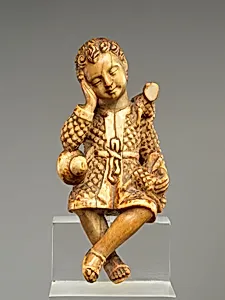
The Good Shepherd
Unknown Artist
18th century
Medium
Ivory
Dimensions
H. 2 5/8 in. (6.7 cm); W. 1 1/4 in. (3.2 cm); D. 1 in. (2.5 cm)
Classification
Ivories
Culture
India, Indo-Portuguese (Goa or Diu)
Department
Asian Art
Museum
Metropolitan Museum of Art, New York, NY
Credit
Gift of Cynthia Hazen Polsky, 2011
Accession Number
2011.576.7
Rights
Public Domain
Tags
Art Historical Context
Nestled in the Metropolitan Museum of Art's Asian department, *The Good Shepherd is a delicate 18th-century sculpture (H. 2 5/8 in.; W. 1 1/4 in.; D. 1 in.) from Indo-Portuguese India, likely Goa or Diu. Carved by an unknown artist, it portrays Jesus as the benevolent shepherd from Christian scripture—a tender figure cradling a lamb, symbol guidance, protection, and sacrifice. This intimate scale suggests it served as a personal devotional object, perhaps a pendant or saint, cherished by Portuguese settlers or converts in colonial India. The artwork exemplifies Indo-Portuguese art, a vibrant fusion born from Portugal's 16th-18th century presence in Goa, a key trading hub. Indian ivory carvers, renowned for their precision, adapted European Christian iconography using local techniques like fine undercutting and polishing to create translucent, lifelike forms. Ivory's rarity and workability made it ideal for such portable treasures, blending Mughal-era finesse with Baroque-inspired emotion. A gift from Cynthia Hazen Polsky in 2011, this piece cultural exchange: Indian artisans interpreting Jesus through their lens, bridging Eastern craftsmanship with Western faith. Visitors will appreciate its serene spirituality and masterful detail up close.