
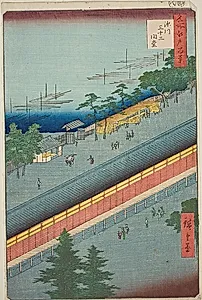
The Hall of Thirty-Three Bays at Fukagawa (Fukagawa Sanjusangendo), No.69 from the series "One Hundred Famous Views of Edo (Meisho Edo hyakkei)"
Medium
Color woodblock print
Dimensions
35 × 23 cm (13 13/16 × 9 1/16 in.)
Classification
woodblock print
Department
Arts of Asia
Museum
Art Institute of Chicago
Accession Number
150315
Rights
Public Domain
Art Historical Context
Utagawa Hiroshige (1797–1858), a master of ukiyo-e woodblock prints, captured the vibrant spirit of Edo (modern Tokyo) in his monumental series *One Hundred Famous Views of Edo* (Meisho Edo hyakkei), published between 1856 and 1859. This stunning color woodblock print, No. 69 titled *The Hall of Thirty-Three Bays at Fukagawa (Fukagawa Sanjusangendo)* from 1857, showcases Hiroshige's genius for landscape and urban scenes. Produced late in his career, the series revolutionized printmaking with its poetic depictions of everyday life, seasonal changes, and iconic sites, influencing later artists like Van Gogh and the Impressionists. The print depicts the elongated Hall of Thirty-Three Bays in Edo's Fukagawa district, a Buddhist temple replica inspired by Kyoto's famous Sanjusangendo, renowned for housing 1,001 statues of the goddess Kannon and hosting thrilling archery contests. Hiroshige masterfully conveys the hall's architectural grandeur against a snowy winter backdrop, with tiny figures emphasizing human scale amid nature's quiet drama. This scene highlights Edo's blend of spirituality and spectacle during the Edo period (1603–1868). Crafted through the collaborative ukiyo-e process—involving designers, carvers, and printers—the 35 × 23 cm print exemplifies Hiroshige's atmospheric use of color gradients and bold compositions. Affordable and widely circulated, such works brought art to the masses, preserving a vanishing urban world on the cusp of Japan's modernization. A gem in the Art Institute of Chicago's Arts of Asia collection, it invites visitors to step into 19th-century Japan.
About the Artist
Utagawa Hiroshige · 1826–1869
Utagawa Hiroshige (1797–1858), born Andō Tokutarō, was the last great master of Japanese ukiyo-e woodblock printmaking and one of the most influential landscape artists in history. Born in Edo (modern Tokyo) into a low-ranking samurai family serving as fire wardens, Hiroshige transformed landscape printmaking into a poetic meditation on nature, weather, and everyday life. His revolutionary approac...