
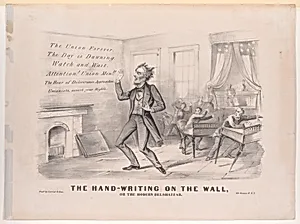
The Hand-Writing On the Wall, Or the Modern Belshazzar
Medium
Lithograph
Dimensions
Image: 9 3/8 × 14 3/16 in. (23.8 × 36 cm) Sheet: 13 7/16 × 18 1/8 in. (34.2 × 46 cm)
Classification
Prints
Department
Drawings and Prints
Museum
Metropolitan Museum of Art, New York, NY
Credit
Gift of A. S. Colgate, 1952
Accession Number
52.632.213
Rights
Public Domain
Tags
Art Historical Context
**The Hand-Writing On the, Or the Modern Belazzar** is a striking 1865 lithograph produced by the renowned New York firm Currier & Ives, attribution to Jefferson Davis in its satirical context. Measuring about 9½ by 14 inches, print exemplifies the firm's mastery of color lithography—a technique that allowed for affordable, mass-produced images blending text and vivid illustration. Currier & Ives specialized in timely scenes of American life, and during the Civil War, they often created Union-leaning propaganda that captured public sentiment through humor and exaggeration. The title draws from the biblical Book of Daniel, where a divine hand writes a prophecy of doom on King Belshazzar's wall, signaling the fall of his empire. Here, it's repurposed as "Modern Belshazzar" to mock Confederate President Jefferson Davis amid the Confederacy's collapse in 1865. As Union victories mounted—culminating in Lee's surrender at Appomattox—this print likely depicts Davis in a moment of hubris turned terror, surrounded by symbols of defeat. Such Civil War satires were cultural touchstones, rallying Northern audiences and disseminating political commentary to homes across the nation. Housed in the Metropolitan Museum of Art's Drawings and Prints department, this work highlights lithography's power as a democratic medium, making sharp social critique accessible. Its enduring tags—American Civil War, satire, men—underscore its role in shaping postwar memory.
About the Artist
Jefferson Davis|Currier & Ives (American|American) · 1857 |1808 –1907 |1889
American, active New York, 1857–1907|American, Fairview, Kentucky 1808–1889 New Orleans, Louisiana