
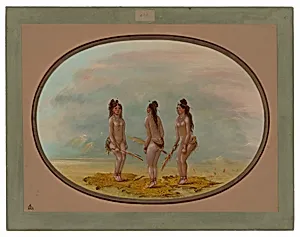
The Handsome Dance - Goo-a-give
1854/1869
Medium
oil on card mounted on paperboard
Dimensions
overall: 45.8 x 62.5 cm (18 1/16 x 24 5/8 in.)
Classification
Painting
Department
CAB
Museum
National Gallery of Art, Washington, D.C.
Credit
Paul Mellon Collection
Accession Number
1965.16.256
Rights
Public Domain
Art Historical Context
George Catlin’s “The Handsome Dance – Goo-a-give” captures a lively ceremonial moment among Native American dancers. Catlin, an American artist and ethnographer, devoted much of his career to recording the appearances, customs, and rituals of Indigenous peoples across the Great Plains and beyond. Painted between 1854 and 1869, the work belongs to the later phase of his Indian Gallery project, when he revisited earlier field sketches to create finished studio pieces for Eastern and European audiences. The medium—oil on card mounted on paperboard—allowed Catlin both portability during his travels and the rich color he needed to convey the energy of movement and costume. Viewers can sense the rhythmic stamping of feet and the swirl of regalia, rendered with the direct, documentary style that made Catlin’s paintings valuable visual records of cultures undergoing rapid change. Today in the National Gallery of Art’s Paul Mellon Collection, the painting continues to introduce visitors to the vitality and dignity of 19th-century Native American life while reminding us of Catlin’s pioneering role in American art and ethnography.
About the Artist
George Catlin · 1796–1872
George Catlin (1796–1872), born in Wilkes-Barre, Pennsylvania, to Putnam Catlin and Polly Sutton—who had been captured by Native Americans during the 1778 Battle of Wyoming—initially pursued a legal career. Trained at Litchfield Law School, he was admitted to the bar in 1819 but abandoned law after two years to study art in Philadelphia in 1823. Self-taught as a portraitist, Catlin quickly gained ...