
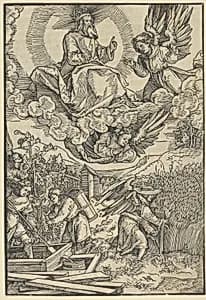
The Harvest and the Wine-Press of Blood
Medium
Woodcut
Dimensions
Sheet: 9 1/4 × 6 3/8 in. (23.5 × 16.2 cm)
Classification
Prints
Department
Drawings and Prints
Museum
Metropolitan Museum of Art, New York, NY
Credit
Harris Brisbane Dick Fund, 1928
Accession Number
28.28.7
Rights
Public Domain
Tags
Art Historical Context
Hans Schäufelein's *The Harvest and the Wine-Press of Blood* is a striking woodcut print, measuring 9¼ × 6⅜ inches, that captures vivid biblical imagery from the Book of Revelation. The title evokes apocalyptic scenes: a divine harvest where angels wield sickles amid fields (echoing the tags of farms, men, and working figures), and the wine-press of blood symbolizing God's judgment, with grapes trodden into a river of wrath. Saints and celestial beings populate the composition, blending earthly labor with heavenly drama in a compact, dynamic scene. As a master of the woodcut medium—carved in relief on wood blocks and hand-printed—Schäufelein exemplifies early 16th-century German printmaking. This technique allowed for affordable dissemination of religious art, making profound theological messages accessible to wide audiences beyond elite patrons. Housed in the Metropolitan Museum of Art's Drawings and Prints department (acquired via the Harris Brisbane Dick Fund in 1928), the work showcases the Northern Renaissance's intricate line work and symbolic density. Culturally, it reflects the era's intense focus on end-times prophecy amid Reformation tensions, inviting viewers to ponder salvation and divine justice. A testament to woodcuts' power, this print remains a window into faith-driven artistry.
About the Artist
Hans Schäufelein · 1480–1540
Hans Schäufelein (c. 1480–c. 1540) was a German painter and graphic artist of the Northern Renaissance whose career placed him at the heart of one of the most dynamic artistic environments in European history. As a young man, he entered the workshop of Albrecht Dürer in Nuremberg, an experience that proved decisive: Dürer's meticulous approach to draughtsmanship, his mastery of printmaking, and hi...