
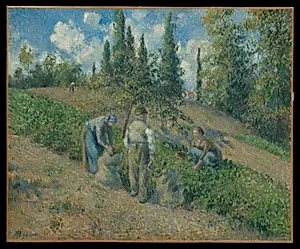
The Harvest, Pontoise (La Récolte, Pontoise)
1881
Medium
Oil on canvas
Dimensions
18 1/8 × 21 3/4 in. (46 × 55.2 cm) Framed: 28 3/8 × 31 15/16 in. (72.1 × 81.1 cm)
Classification
Paintings
Department
Robert Lehman Collection
Museum
Metropolitan Museum of Art, New York, NY
Credit
Robert Lehman Collection, 1975
Accession Number
1975.1.197
Rights
Public Domain
Tags
Art Historical Context
Camille Pissarro’s *The Harvest, Pontoise* (1881) captures the quiet rhythm of rural life in late-nineteenth-century France. An oil-on-canvas scene of men and women gathering crops near the village of Pontoise, the painting reflects the artist’s lifelong interest in peasant labor and the changing seasons. Working in the open air, Pissarro recorded the modest gestures of harvest work with loose, broken brushstrokes that convey both movement and the play of sunlight across fields. As a central figure of Impressionism, Pissarro often chose such everyday subjects to celebrate the dignity of agricultural work at a time when rapid urbanization was transforming France. The modest scale of the canvas—roughly eighteen by twenty-two inches—invites viewers to linger over the figures’ bent backs and the golden stubble, offering an intimate glimpse of communal effort rather than heroic drama. Today in the Metropolitan Museum’s Robert Lehman Collection, the work stands as a vivid reminder of Pissarro’s belief that ordinary landscapes could carry profound social and poetic meaning.
About the Artist
Camille Pissarro · 1831–1903
Camille Pissarro (1830-1903) stands as the patriarch of Impressionism, the only artist to exhibit in all eight Impressionist exhibitions and a mentor whose influence shaped the trajectory of modern art. Born Jacob Abraham Camille Pissarro on the Caribbean island of St. Thomas to a Jewish-Portuguese merchant family, he abandoned the family business to pursue painting, eventually settling in Paris i...