
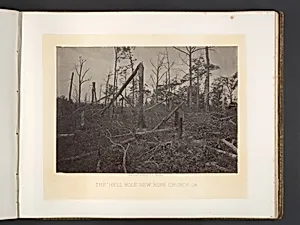
The "Hell Hole" New Hope Church, Georgia
1860s
Medium
Albumen silver print from glass negative
Classification
Photographs
Department
Photographs
Museum
Metropolitan Museum of Art, New York, NY
Credit
Pfeiffer and Rogers Funds, 1970
Accession Number
1970.525 (27)
Rights
Public Domain
Tags
Art Historical Context
Step into the scarred landscapes of the American Civil War with George N. Barnard's *The "Hell Hole" New Hope Church, Georgia*, an evocative albumen silver print from the 1860s. Barnard, a pioneering photographer embedded with Union forces during General William T. Sherman's Atlanta Campaign, captured this haunting view of New Hope Church—a rural Georgia site infamous for brutal fighting in May 1864. The nickname "Hell Hole" evokes the chaos of Confederate defenses against Sherman's advancing troops, where entrenchments and artillery turned peaceful fields into a vision of devastation. This photograph's power lies in its stark documentation of war's toll on the Southern countryside. Barnard's glass negative, printed via the albumen process—a 19th-century technique using egg whites to bind light-sensitive silver salts—yields rich tonal depth and fine detail, making the print both a historical record and an artistic achievement. Amid churned earth and skeletal trees, the modest church stands as a poignant survivor, symbolizing resilience amid ruin. Housed in the Metropolitan Museum of Art, this image from Barnard's seminal *Photographic Views of Sherman's Campaign* (published 1866) offers visitors a visceral glimpse into Civil War photography's role in shaping public memory, blending landscape beauty with the grim reality of conflict.
About the Artist
George N. Barnard · 1819–present
George N. Barnard (1819–1902) was a pioneering American photographer whose six-decade career spanned the dawn of the medium, from daguerreotypes to Civil War documentation. Born into a farming family in Coventry, Connecticut, on December 23, 1819, he lost his father at age seven and apprenticed in family businesses before marrying in 1843 and relocating to Oswego, New York. There, he launched one ...