
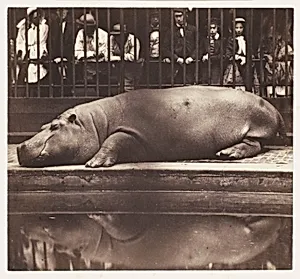
The Hippopotamus at the Zoological Gardens, Regent's Park
1852
Medium
Salted paper print from glass negative
Dimensions
Image: 11.1 × 12 cm (4 3/8 × 4 3/4 in.) Mount: 43.8 × 30.5 cm (17 1/4 × 12 in.)
Classification
Photographs
Department
Photographs
Museum
Metropolitan Museum of Art, New York, NY
Credit
Gilman Collection, Purchase, Ann Tenenbaum and Thomas H. Lee Gift, 2005
Accession Number
2005.100.14
Rights
Public Domain
Tags
Art Historical Context
In 1852, Spanish nobleman Juan de Borbón *The Hippopotamus at Zoological Gardens, Regent Park*, a pioneering salted paper print made from a glass negative. intimate 11.1 × 12 cm image depicts a massive hippopotamus in London's famed Regent's Park Zoo—opened in 1828 as a hub for scientific study and public spectacle—surrounded by curious men and women gazing at the exotic beast. De Borbón, a pretender to the Spanish throne avid early photographer, documented this slice of Victorian life during a time when zoos symbolized imperial exploration and the wonders of the natural world transported from Africa. The salted paper process, one of photography's first positive printing methods refined in the 1840s, produced soft, warm-toned images with subtle detail, highlighting the hippo's textured hide and the visitors' period attire. Printed on a large 43.8 × 30.5 cm mount, it exemplifies the calotype era's technical innovations before faster wet-collodion processes dominated. As part of the Metropolitan Museum of Art's Gilman Collection, this rarity underscores photography's rapid evolution from scientific tool to artistic medium, offering a window into 19th-century fascination with the "exotic" and the dawn of mass visual culture.