
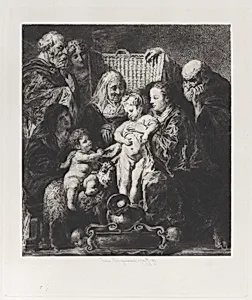
The Holy Family, after Jacob Jordaens
Medium
Etching, third state of five (Gonse)
Dimensions
Sheet: 18 1/8 × 13 1/2 in. (46 × 34.3 cm) Plate: 7 7/8 × 5 7/8 in. (20 × 15 cm)
Classification
Prints
Department
Drawings and Prints
Museum
Metropolitan Museum of Art, New York, NY
Credit
Purchase, 1871, transferred from the Department of Paintings
Accession Number
19.59.8
Rights
Public Domain
Tags
Art Historical Context
Behold *The Holy Family, after Jacob Jordaens*, exquisite 19th-century etching that captures the warmth and grandeur of Flemish Baroque master Jacob Jordaens (1593–1678). Depicting the tender scene of the Virgin Mary cradling the Christ Child, surrounded by Saint Joseph, Saint Anne, and the young John the Baptist, it echoes Jordaens' signature style—vibrant, earthy compositions blending religious devotion with everyday humanity. Jordaens, a leading Antwerp painter and Rubens contemporary, often portrayed sacred subjects with robust figures and rich emotional depth, making this reproductive print a window into 17th-century Flemish art. Crafted in 1871 by acclaimed French etcher Jules-Ferdinand Jacquemart and published by the esteemed London firm P. & D. Colnaghi & Co., this is the third state of five, as cataloged by critic Louis Gonse. Etching, an intaglio technique where acid bites into a metal plate to create fine lines, allowed precise replication of Jordaens' originals for wider audiences. Acquired by the Metropolitan Museum of Art that year and later transferred from Paintings to Drawings and Prints, it reflects the 19th-century boom in high-quality reproductive prints, bridging Old Masters with Victorian collectors. This intimate plate (7⅞ × 5⅞ in.) on a larger sheet evokes the Holy Family's enduring cultural role as symbols of faith, protection, and lineage, inviting visitors to ponder its timeless spiritual resonance.
About the Artist
P. & D. Colnaghi & Co.|Jacob Jordaens|Jules-Ferdinand Jacquemart ( |French) · 1760 |1837 –9999 |1880
|French, Paris 1837–1880 Paris