
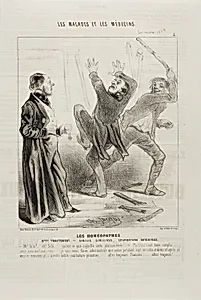
The Homeopaths: Second Treatment (plate 5)
Medium
Lithograph in black on ivory wove paper
Dimensions
Image: 22.3 × 18.7 cm (8 13/16 × 7 3/8 in.); Sheet: 35.1 × 23.6 cm (13 7/8 × 9 5/16 in.)
Classification
lithograph
Department
Prints and Drawings
Museum
Art Institute of Chicago
Accession Number
51106
Rights
Public Domain
Art Historical Context
**The Homeopaths: Second (plate 5)** is a lithograph created by French artist Charles Émile Jac in 1843, part of a satirical series poking fun at the rising popularity of homeopathy in mid-19th-century France. Jacque (3–1894), a master printmaker associated with the Barbizon School was renowned for his detailed depictions of rural life and animals, but here he turned his keen eye to social commentary. This plate, the fifth in the sequence, captures the "second treatment" in a humorous or critical light, reflecting debates over alternative medicine during an era when conventional practices were being challenged. Printed in black ink on ivory wove paper, the work measures 22.3 × 18.7 cm for the image, showcasing lithography's versatility. Invented decades earlier, this technique allowed artists like Jacque to draw directly on stone with greasy crayon, producing rich tonal variations and fine lines ideal for caricature. Housed in the Art Institute of Chicago's Prints and Drawings Department, it exemplifies how 19th-century prints democratized art, making sharp social critique accessible beyond elite circles. In 1843, homeopathy—pioneered by Samuel Hahnemann—was gaining traction amid skepticism toward bloodletting and harsh remedies, yet often dismissed as quackery. Jacque's series highlights this cultural tension, blending artistry with wit to entertain and provoke visitors to reconsider medical fads of the past. A delightful glimpse into Victorian-era satire! (198 words)