
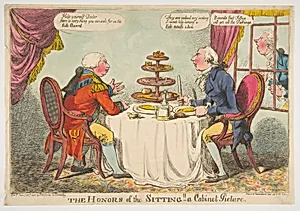
The Honors of the Sitting! A Cabinet Picture
January 30, 1805
Medium
Hand-colored etching
Dimensions
sheet: 9 1/2 x 13 3/4 in. (24.2 x 34.9 cm)
Classification
Prints
Department
Drawings and Prints
Museum
Metropolitan Museum of Art, New York, NY
Credit
Gift of Adele S. Gollin, 1976
Accession Number
1976.602.36
Rights
Public Domain
Tags
Art Historical Context
Created in 1805 by British caricaturist Charles Williams and published by S.W.ores, *The Honors of the Sitting! A Cabinet Picture* is a hand-colored etching that playfully skewers the intersection of politics and dining. Measuring just 9½ by 13¾ inches, this modest print belongs to the lively tradition of Georgian satire, where everyday social rituals became vehicles for commenting on power and privilege. The title itself puns on “cabinet”—both a small painting and the government’s inner circle—hinting at a scene of men gathered around a table where political “honors” are served alongside the meal. Hand-colored etchings like this one were the mass media of their day, allowing sharp visual commentary to reach a wide audience quickly and affordably. Williams’s lively line work and the bright watercolor washes draw attention to the figures’ expressions and the abundant food, turning a seemingly ordinary dinner into a pointed reflection on how political alliances were often forged over lavish spreads. Now part of the Metropolitan Museum’s collection of prints, the work offers today’s visitors a vivid glimpse into early-nineteenth-century British culture, where humor and art combined to critique the powerful.
About the Artist
Charles Williams|S. W. Fores · 1797–1830
Charles Williams (1797–1830) was a British caricaturist and printmaker who worked in London during the final decades of the Georgian era, producing satirical prints for the thriving trade in political and social caricature that flourished in the city's print shops. He worked in the tradition established by such masters as James Gillray and Thomas Rowlandson, whose biting visual commentary on polit...