
The Interior of the Palm House on the Pfaueninsel Near Potsdam
1834
Medium
Oil on canvas
Dimensions
135 × 126 cm (52 1/2 × 50 in.); Framed: 155 × 145.5 cm (61 × 57 1/4 in.)
Classification
oil on canvas
Department
Painting and Sculpture of Europe
Museum
Art Institute of Chicago
Accession Number
144969
Rights
Public Domain
About this artwork
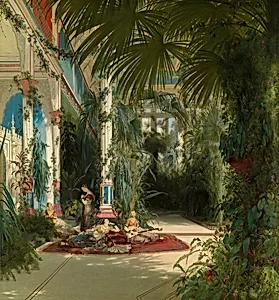
Lush palms and overgrown greenery dominate this view of the Palm House, designed by Karl Friedrich Schinkel to display the Prussian royals’ collection of tropical plants. This painting plays with the boundaries between architecture and nature, imagination and reality: vines curl around soaring columns and bowed fronds evoke archways. Carl Blechen populated his dazzling place-portrait with a leisure scene derived from colonialist fantasies of non-European women. The artist dressed the figures in r...
Art Historical Context
In Carl Blechen’s 1834 oil on canvas, *The Interior of the Palm House on the Pfaueninsel Near Potsdam*, visitors encounter a lush tropical world enclosed within an elegant glass-and-iron structure. Measuring over four feet square, the painting draws the eye through rows of towering palms and exotic plants toward the light streaming through the transparent roof, creating a striking contrast between ordered architecture and abundant nature. Blechen, a leading German Romantic painter, often explored the interplay of light, atmosphere, and place. Here he records a celebrated feature of Peacock Island, the Prussian royal retreat near Potsdam. Built to house rare botanical specimens gathered from distant lands, the palm house embodied the early-nineteenth-century enthusiasm for scientific exploration, global trade, and innovative glass architecture that allowed Europeans to cultivate tropical flora in northern climates. The work’s warm, glowing light and meticulous detail invite viewers to experience both the wonder of these imported plants and the quiet drama of their artificial environment. Today in the Art Institute of Chicago, the painting offers a vivid glimpse into Romantic-era ideals of nature, empire, and human ingenuity.