
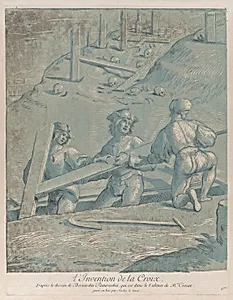
The invention of the cross; three men lifting a cross from a trench; from 'Recueil d'estampes d'après les plus beaux tableaux et d'après les plus beaux desseins qui sont en France, Cabinet Crozat' after a drawing by Pinturicchio
Medium
Etching and aquatint with tone woodblock
Dimensions
Sheet: 20 7/8 × 15 1/16 in. (53.1 × 38.3 cm) Plate: 16 1/8 × 12 3/8 in. (41 × 31.5 cm)
Classification
Prints
Department
Drawings and Prints
Museum
Metropolitan Museum of Art, New York, NY
Credit
Gift of Harry G. Friedman, 1960
Accession Number
60.708(72)
Rights
Public Domain
Art Historical Context
In the heart of Renaissance storytelling, this etching captures a pivotal moment from the Legend of the True Cross: men laboring to lift the sacred cross from a trench,izing its "invention" or discovery. Originally a drawing by the Italian master Bernardo di Betto, known as Pinturicchio (ca. 1454–1513), a key figure in the Umbrian school alongside Perugino, the scene brims with narrative drama and intricate detail typical of his late 15th-century style.uricchio's works often adorned grand fresco cycles, blending vivid humanism with religious fervor. French printmaker Nicolas Le Sueur faithfully reproduced it around 1729–64 as part of the lavish *Recueil d'estampes d'après les plus beaux tableaux et d'après les plus beaux dessins qui sont en France, Cabinet Crozat*. This opulent volume documented treasures from Pierre Crozat's renowned private collection, making elite art accessible through innovative techniques: etching for precise lines, aquatint for subtle shading, and tone woodblock for rich atmospheric depth. At 20⅞ × 15⅛ inches, the sheet invites viewers into 18th-century connoisseurship, bridging Renaissance devotion with Enlightenment print culture. A gift to the Metropolitan Museum of Art in 1960, it exemplifies how prints preserved and democratized artistic heritage.