
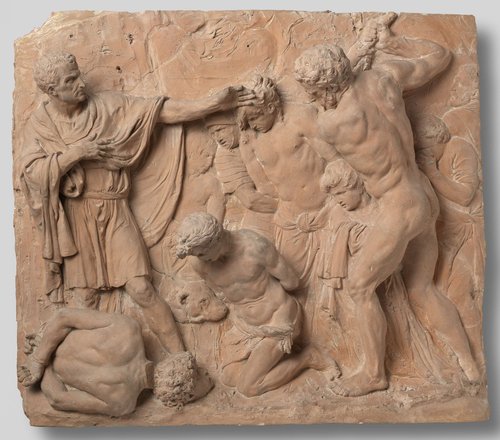
The Judgement of Lucius Junius Brutus, Model for a Relief in the Vierschaar of the Amsterdam Town Hall (now Royal Palace) at Dam Square
ca. 1650 - ca. 1652
Medium
terracotta
Dimensions
72; 20; 83.5
Rights
Public Domain
About this artwork
In het midden op de voorgrond knielt driekwart naar links gekeerd Brutus' jongste zoon met de handen op de rug in afwachting van de bijlslag, die de achter hem staande beul hem zal toebrengen. Deze, geheel naakt en met de rug driekwart naar de beschouwer, houdt de bijl met beide handen boven het hoofd. Geheel links Brutus' tuniek en toog, frontaal, staande op het rechterbeen en met het linker zijwaarts. Hij houdt de rechterarm voor de borst, het vertrokken gelaat naar rechts en de gestrekte link...
Art Historical Context
Artus Quellinus (I), a leading Flemish sculptor of the era, created this expressive terracotta model around 1650–1652 as a preparatory study for a marble relief in the Vierschaar, the tribunal chamber of Amsterdam’s new Town Hall (now the Royal Palace) on Dam Square. The depicts the Roman consul Lucius Junius Brutus condemning his own sons to death for treason, a powerful classical story that underscored ideals of impartial justice and civic duty—values central to the Dutch Republic’s self-image during its Golden Age. Measuring just over 70 centimeters high, the compact terracotta captures dramatic action in high relief: the youngest son kneels awaiting the axe, while Brutus gestures sternly from the left and the headless body of his elder son lies at his feet. Visible horizontal and vertical grooves indicate how the design was transferred to the final stone carving. Quellinus’s dynamic composition and vivid rendering of emotion helped shape one of the most important public art programs of seventeenth-century Amsterdam, transforming the Town Hall into a monumental statement of republican virtue.