
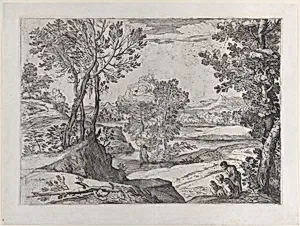
The Landscape With the Family
Medium
Etching; first state of two
Dimensions
Plate: 11 × 15 5/16 in. (27.9 × 38.9 cm) Sheet: 12 15/16 × 17 3/16 in. (32.8 × 43.6 cm)
Classification
Prints
Department
Drawings and Prints
Museum
Metropolitan Museum of Art, New York, NY
Credit
Gift of Kenneth Grebinar, 2005
Accession Number
2005.377.73
Rights
Public Domain
Art Historical Context
Giovanni Francesco Grimaldi, Italian Baroque artist known as "Il Bolog" (1606–1680), created *The Landscape With the Family in 1643 as an etching in its rare first state of two. primarily in Rome, Grimaldi specialized in idyllic landscapes infused with classical ruins and serene figures, reflecting the era's fascination with nature as a harmonious backdrop to human life. This print captures a pastoral scene likely featuring a family amid expansive vistas, evoking the grandeur of the Roman countryside that inspired many 17th-century artists. Etching allowed Grimaldi to achieve delicate, fluid lines with acid-bitten precision on a copper plate, a technique popularized in the Baroque period for reproducing detailed compositions affordably. As a first-state impression—before any revisions to the plate—this example preserves the artist's purest vision, making it a prized collector's item. Measuring about 11 by 15 inches on the plate, its intimate scale invites close viewing of intricate foliage, distant architecture, and subtle tonal gradations. Generously gifted to the Metropolitan Museum of Art in 2005 by Kenneth Grebinar, this work exemplifies the flowering of landscape printmaking in 17th-century Italy, bridging painting and graphic arts while offering visitors a window into Grimaldi's poetic interpretation of the eternal landscape.
About the Artist
Giovanni Francesco Grimaldi · 1606–1680
Giovanni Francesco Grimaldi (1606–1680), known as "Il Bolognese," was an Italian painter, draughtsman, and etcher whose career exemplifies the wide influence of the Bolognese school of landscape painting in seventeenth-century Rome. Born in Bologna, Grimaldi trained in the tradition of the Carracci, whose idealized approach to landscape — blending careful observation of nature with classical compo...