
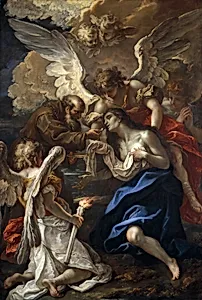
The Last Communion of Saint Mary of Egypt
c. 1695
Medium
oil on canvas
Dimensions
overall: 209 x 142 cm (82 5/16 x 55 7/8 in.) framed: 236.2 x 170.8 cm (93 x 67 1/4 in.)
Classification
Painting
Department
CIS-B
Museum
National Gallery of Art, Washington, D.C.
Credit
Patrons' Permanent Fund
Accession Number
2003.85.1
Rights
Public Domain
Art Historical Context
Sebastiano Ricci's *The Last Communion of Mary of Egypt* (c. 1695) captures a poignant moment from the life of the 5th-century saint, a former prostitute who repented and lived as a desert hermit. Here, the emaciated Mary receives her final Eucharist from the monk Zosimas, her human contact after decades of solitude. Painted in oil on canvas—a medium prized for its luminous depth and ability to render flesh tones and dramatic light—this large-scale work (209 x 142 cm) draws viewers into a scene of profound spiritual redemption. Ricci, a leading Venetian Baroque artist, infuses the composition with theatrical energy and swirling movement, hallmarks of his style influenced by masters like Titian and Veronese. His masterful use of chiaroscuro heightens the emotional intensity, spotlighting Mary's serene ecstasy amid ethereal angels and rugged desert backdrop. Created during Venice's late Baroque era, when religious art emphasized dramatic piety amid Counter-Reformation fervor, the painting exemplifies Ricci's skill in blending narrative storytelling with opulent color and fluid forms. Acquired through the National Gallery of Art's Patrons' Permanent Fund, this masterpiece invites reflection on themes of forgiveness and grace, reminding us of art's power to make sacred stories vividly alive.
About the Artist
Sebastiano Ricci · 1659–1734
Sebastiano Ricci (1659–1734) was born in Belluno, in the Venetian Republic, and received his early training in Venice, where he was apprenticed at age twelve to the Milanese painter Federico Cervelli. Some accounts identify Sebastiano Mazzoni as his first master. A youthful scandal involving an unintended pregnancy and a charge of attempted poisoning led to imprisonment in 1678, from which he was ...