
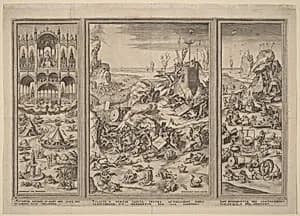
The Last Judgment Triptych
Medium
engraving on laid paper
Dimensions
plate: 33.5 × 49.2 cm (13 3/16 × 19 3/8 in.) sheet: 37.5 × 52.1 cm (14 3/4 × 20 1/2 in.)
Classification
Department
CG-E
Museum
National Gallery of Art, Washington, D.C.
Credit
Print Purchase Fund (Rosenwald Collection)
Accession Number
1971.7.1
Rights
Public Domain
Art Historical Context
The Last Judgment Triptych is a finely detailed engraving produced around 1560–1570 by Cornelis Cort, working after a follower of Hieronymus Bosch. Created on laid paper, the print reproduces the format of a traditional altarpiece triptych, with its central panel and folding wings designed to unfold dramatic scenes of salvation and damnation. Bosch’s distinctive vision—populated by fantastical creatures, tormented souls, and moral warnings—remained highly influential decades after his death in 1516, and Cort’s reproductive engraving helped carry that imagery to new audiences across Europe. As a reproductive print rather than an original painting, the work highlights the growing importance of engraving in the sixteenth century. Skilled engravers like Cort translated the intricate, crowded compositions of Netherlandish masters into precise lines that could be printed and distributed widely. This medium allowed complex religious narratives, once limited to church settings or wealthy collectors, to reach a broader public while preserving the original’s moral intensity. The subject itself reflects late medieval and early modern preoccupations with death, judgment, and the afterlife. Through its meticulous technique and dramatic iconography, the engraving invites viewers to contemplate both spiritual consequences and the remarkable artistry that kept Bosch’s unsettling world alive long after his lifetime.