
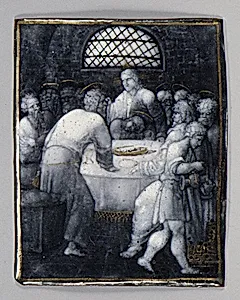
The Last Supper (one of seven)
mid-16th century
Medium
Painted enamel on copper, partly gilt
Dimensions
2 3/4 × 2 3/8 in. (7 × 6 cm)
Classification
Enamels
Culture
French, Limoges
Department
European Sculpture and Decorative Arts
Museum
Metropolitan Museum of Art, New York, NY
Credit
Gift of George Blumenthal, 1941
Accession Number
41.100.250b
Rights
Public Domain
Tags
Art Historical Context
Behold this delicate gem from Renaissance France: *The Last Supper (one seven)*, created in the mid-16th century by the enamellers Jean II Pénicaud and Jean III Picaud of Limoges. Measuring just 2¾ × 2⅜ inches, this painted enamel on copper—partly gilded—captures the biblical scene of Jesus sharing his final meal with the apostles in miniature detail. Housed in the Metropolitan Museum of Art's European Sculpture and Decorative department, it entered the collection as a gift from George Blumenthal in 1941. Limoges was Europe's unrivaled center for enamel production during the 16th century, where artists like the Pénicauds elevated the craft to painterly heights. They applied finely ground glass powders in translucent layers onto a copper base, firing the piece multiple times in a kiln to achieve luminous depth, rich colors, and subtle gilding highlights. This technique blended the precision of jewelry-making with the intimacy of panel painting, making such works ideal for personal devotion, reliquaries, or wearable art. As one of a presumed series of seven—likely exploring key religious moments—this enamel reflects the era's fervent Catholic piety amid the Reformation's upheavals. Its small scale invites close contemplation, turning a grand narrative into a treasured, pocket-sized icon of faith and artistry.