
The Lictors Bringing Brutus the Bodies of his Sons
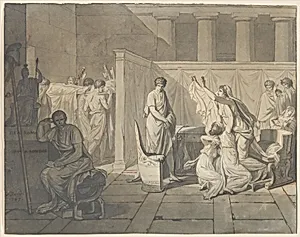
Medium
Black chalk, pen and black and brown ink, brush and gray and brown wash, heightened with white gouache
Dimensions
Sheet: 13 1/16 x 16 9/16 in. (33.2 x 42.1 cm)
Classification
Drawings
Department
Drawings and Prints
Museum
Metropolitan Museum of Art, New York, NY
Credit
Purchase, Lila Acheson Wallace Gift, 2006
Accession Number
2006.264
Rights
Public Domain
Tags
Art Historical Context
Jacques-Louis David’s 1787 drawing captures a pivotal moment from ancient Roman history: the consul Brutus stoically receiving the bodies of his sons, whom he had condemned to death for conspiring against the Republic. Created just two years before the French Revolution, the scene embodies the Neoclassical ideal of civic virtue triumphing over personal emotion. David, the leading painter of his generation, used this austere subject to explore themes of duty and sacrifice that resonated deeply with Enlightenment audiences. Executed in black chalk, pen, ink, and wash heightened with white gouache, the sheet reveals David’s meticulous preparatory process. The layered media allow for dramatic contrasts of light and shadow, emphasizing the rigid geometry of the lictors’ fasces and Brutus’s impassive pose. Measuring roughly 13 by 16½ inches, the drawing served as a compositional study for the monumental oil painting David exhibited at the 1789 Salon. Today housed in the Metropolitan Museum’s Department of Drawings and Prints, this work offers visitors an intimate glimpse into how David refined his vision of moral gravity. Its crisp lines and restrained emotion helped define Neoclassicism’s visual language, inspiring generations of artists and statesmen alike.
About the Artist
Jacques Louis David · 1748–1825
Jacques-Louis David (1748–1825), born in Paris on August 30 to a prosperous family, faced early tragedy when his father was killed in a duel around age nine. Raised by his mother's two architect uncles after his mother departed, David overcame family resistance to architecture and a facial tumor that hindered his speech and studies at the Collège des Quatre-Nations. He began training under the Roc...