
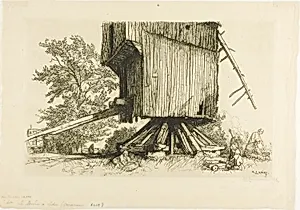
The Lidor Windmill
Medium
Etching on cream laid Japanese paper
Dimensions
Image/plate: 17.2 × 27.2 cm (6 13/16 × 10 3/4 in.); Sheet: 22.8 × 32.4 cm (9 × 12 13/16 in.)
Classification
etching
Department
Prints and Drawings
Museum
Art Institute of Chicago
Accession Number
74751
Rights
Public Domain
Art Historical Context
Louis Auguste Lepère's *The Lidor Windmill (1910) captures the timeless charm of a rural windmill, likely inspired by the iconic structures of northern Europe. A master French printmaker (1849–1918), Lepère was celebrated for his detailed etchings of architecture and landscapes, blending Realism with a keen eye for atmospheric light and texture. Created during the Belle Époque this work reflects the era's fascination with pastoral scenes amid rapid industrialization, evoking nostalgia for traditional countryside life. Rendered as an etching on luxurious cream laid Japanese paper, the print showcases Lepère's technical prowess in intaglio printing. Etching involves drawing lines into a metal plate with acid, allowing for intricate lines that convey the windmill's weathered sails and sturdy form against a vast sky. The choice of Japanese paper—smooth yet absorbent, prized by European artists influenced by Japonisme—enhances the image's subtlety and depth, making it a fine example of early 20th-century printmaking innovation. Housed in the Art Institute of Chicago's Prints and Drawings department, this 17.2 × 27.2 cm plate exemplifies Lepère's contribution to the revival of original prints as collectible art, bridging 19th-century traditions with modern sensibilities. Visitors will appreciate its quiet drama, a window into a vanishing world.
About the Artist
Louis Auguste Lepère · 1849–1918
Louis-Auguste Lepère (1849–1918) was born in Paris on November 30 to the sculptor François Lepère, immersing him early in the artistic world. At age thirteen, he apprenticed in the studio of the English wood engraver Joseph Burn-Smeeton, training there from 1862 to 1867, and later attended drawing courses under Horace Lecoq de Boisbaudran at the Petite École (now École nationale supérieure des art...