
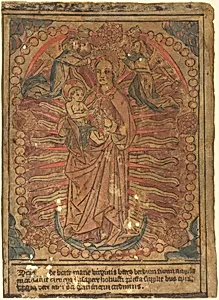
The Madonna and Child in a Rosary
c. 1490
Medium
woodcut, hand-colored in mauve purple, vermilion, gray-blue, probably by stencil
Dimensions
sheet: 24.5 × 17.5 cm (9 5/8 × 6 7/8 in.)
Classification
Department
CG-E
Museum
National Gallery of Art, Washington, D.C.
Credit
Rosenwald Collection
Accession Number
1943.3.568
Rights
Public Domain
Art Historical Context
Step into the devotional world of late 15th-century France *The Madonna and Child in a Rosary*, a delicate woodcut created around 1490. This intimate print, measuring just 24.5 × 17.5 cm, captures the tender embrace of the Virgin Mary and the Christ Child, framed within a rosary bead border—a poignant symbol of prayer and piety during the Gothic era's waning years. Crafted as a hand-colored woodcut, the artwork showcases early printmaking ingenuity. Woodcuts allowed for relatively affordable reproduction of sacred images, making religious art accessible beyond elite patrons. The subtle hues of mauve purple, vermilion, and gray-blue, likely applied via stencil, add a luminous, jewel-like quality, enhancing its appeal for personal altars or meditation. This stenciling technique was a hallmark of the period, transforming stark black-line prints into vibrant, colorful treasures. Housed in the National Gallery of Art's Rosenwald Collection, this piece reflects the era's surging devotion to the rosary, popularized by figures like Alan de la Roche. It bridges medieval manuscript illumination and the coming Renaissance, offering visitors a window into how faith was visualized and venerated in everyday life.